A Girl’s Life in the Siege of Leningrad- The Russian Anne Frank

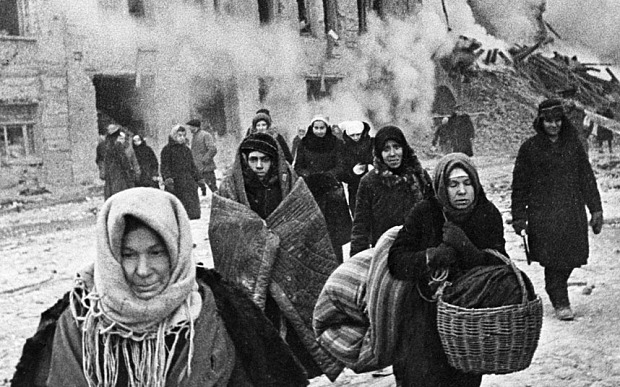
Russian women emerge from an air-raid shelter during the German blockade of Leningrad from 1941. Photo Alamy

There are too many interesting books that I will probably never have time to read. This is one of them.  So I will settle for a few reviews of the book.  The diary of Russian teenager Lena Mukhina was recently released.  She survived the horrors of the siege of Leningrad during WW2.  Over 700,000 civilians died in the battle. Some have called her the Russian Anne Frank.

Stalin said “a single death is a tragedy, a million deaths is a statistic.”  This statement sadly and accurately reflects how we respond to waves of human suffering expressed in massive statistics.  Its almost like 700,000 isn’t a real number for us.  It is too much to wrap our minds around. We get weary. We yawn. We move on.  As a result, biographies and diaries can help us see beyond the statistics to the depth of human tragedy.  An individual story can make atrocities in the abstract become concrete. 

A few things stood out from the review. The first is the bizarre nature of the propaganda pumped out by the Russians.  Socialism has been a catastrophic failure, but you would never know it from listening to socialists, even when the city is burning.

Lena Muchina [Photo: Ullstein Buchverlage]
“By the time she returns to Leningrad at the end of August, the city is surrounded. On 8 September, the same day that the last road out of the city was captured, the Germans launched their first raid. Lena’s diary becomes a Blitz-like record of sirens, midnight dashes to a basement shelter and long, frightening hours spent listening to the thunder of explosions and anti-aircraft fire outside. Having earlier uncritically regurgitated Sovinform assurances that the Germans were surrendering en masse, she starts questioning government propaganda, scoffing at a radio report that fires are being ‘quickly extinguished’: ‘Quickly indeed, they were burning for five hours!’ News of the fall of Kiev shocks her into her only direct criticism of the leadership: ‘I’m no longer sure they’re not going to surrender Leningrad … So many loud words and speeches: Kiev and Leningrad are unassailable fortresses! … But now this.’

Also, I am struck by the horrors of the siege and the effect of starvation on the human soul. All of this is so foreign to me. I have a hard time imagining such cruelty and desperation because I have never experienced it. I can’t imagine being so hungry that eating wall paper paste would be a welcome treat.

“In the depths of the siege winter, many households disintegrated emotionally as well as physically. Lena’s held together. Her mother continued to walk to her workplace daily, bringing home and sharing whatever she was given for ‘lunch’. A windfall was sheets of carpenter’s glue, which could be boiled up and turned into edible jelly. Aka [her governess] queued at the bread shops, for hours at a time, in temperatures that dipped into the minus thirties. Both adults turned a blind eye when Lena hid the pathetic quantities of ‘meat jelly’ she brought home from school. By the end of the year, though, Aka was too weak to leave her bed. ‘Aka’, Lena records on 28 December,, ‘is just an extra mouth to feed. I don’t know how I can even bring myself to write such things. But my heart has turned to stone. The thought of it doesn’t upset me at all… If she is going to die I hope it happens after the 1st, so we’ll be able to get her ration card.’ Aka obliges, dying on New Year’s Day. A few weeks later Lena’s mother follows suit: a one-line entry for 8 February reads, ‘Mama died yesterday morning. I am all alone.’ From then on, Lena fights as much against despair as against hunger: ‘When I wake up in the morning, at first I can’t believe that Mama has really died … But then the awful reality sinks in. Mama has gone! Mama is no longer alive! … I feel like howling, screaming, banging my head against the wall and biting myself! How am I going to live without Mama?’

lena_cover_3205212a

Source: Literary Review – Anna Reid on the Siege of Leningrad

How Do You Face Cancer When Your Job Is To Make People Laugh?

Best of Times-2

What is it like when your child has cancer? Sad. Confusing. Exhausting. Unbearable.

What is like when your child has cancer, and your job is to make people laugh? How does a comedian cope with tragedy?

This is a very moving story, told by Anthony Griffith the comedian about the time in his life when his career was at his highest, while at the same time coping with his daughter’s cancer.

Very powerful. Some strong language. Makes you think about what is truly important.

It often takes an episode of tragedy or loss to wake us up to what is important. But, the most important things are still right there in front of us when everyone is healthy. A word to the wise…

The camera is shaky for the first minute, but it settles down. A good use of 10 minutes of your life.

Why Does It Take So Long to Say We Are Sorry?

Why does it take so long to say that we are sorry? To acknowledge wrong doing and ask for pardon? Why do whole societies refused to acknowledge their past injustices and thereby turn them into present evils? Why do onlookers stand by, becoming complicit by their silence and inaction? Why are we more afraid of the loss of money, influence, and political good will than we are for the cancer of cowardice that grows inside when we stand by in silence?

Armenian Memorial

I just attended an important event at the Armenian Genocide memorial at Fresno State.  It was very moving to me. My eyes were filled with tears. I am sad to say that before moving to Fresno in 2009 I hadn’t even heard of this event. But many Armenian friends have shared the history and even personal accounts from their families.  Oddly enough, I had tears in part because of the great injustice, but they were also tears of joy because an evangelical Turkish pastor had come to continue a process of reconciliation and healing. Even though others would not acknowledge the genocide, he was there to acknowledge, apologize, and seek reconciliation among brothers in Christ. It was a beautiful event. It was a miracle a century in the making.

This year is the 100th anniversary of this great evil, and still the government of Turkey and many others refuse to acknowledge that it even happened, let alone to apologize.  My own president and government have refused to make a simple statement using that “G” word.  And it is strange because the U.S. Doesn’t even need to apologize as the perpetrators of what happened in 1915. We don’t need to acknowledge that WE did it.  We just need to acknowledge that someone else did a great crime. But so far, we won’t. But I am hopeful that this will change.

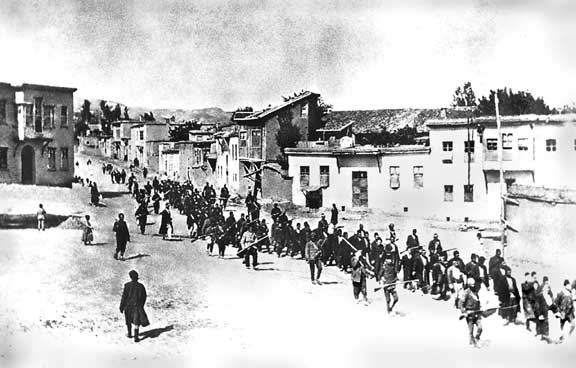
Armenians_marched_by_Turkish_soldiers,_1915
Armenians marched by Turkish soldiers in 1915


When we refuse to call evil exactly what it is, we give it power.  Others may be emboldened to repeat similar acts with a sense of impunity. It was only 24 years after the great outbreak of the genocide in 1915 that Hitler acknowledged it, but in a sinister way. He said, “who, after all speaks today of the annihilation of the Armenians.”  He was posturing for the annihilation of the Jews, and he viewed this as the trial run.  The worldwide silence on this issue, the failure of other nations to intervene or even “remember” what happened while the events were still fresh in memory had implications. It inspired Hitler. It made him feel that he could not only repeat these acts, but that he could get away with it. He interpreted the silence and concluded hat this group of people were so despised that the world would be better off for their destruction. Such are the depraved justifications of mad men.

But why would it take so long for a nation like ours, one so entangled in its own quest for social justice, to even call this event what it is?

There are many answers, but none of them will can bear the weight of our silence.  What does matter is that now we have become part of the problem, we have refused to leave the great stream of indifference that flows through history.  Even while we pat ourselves on the back for our moral progress.  Now, even though we weren’t the perpetrators we need to apologize for failing to act, and failing to offer the simple gesture of words. We must ask forgiveness for our unwillingness to pay the price for speaking the truth. And we must acknowledge that it took us far too long to do it.

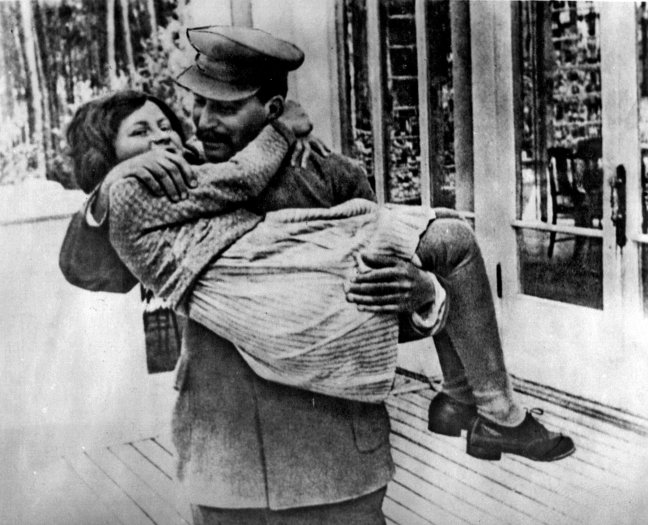
When Father Is A Monster: Stalin’s Daughter

Joseph Stalin was a monster who often treated his friends worse than his enemies. What was it like to be his daughter? Horrible.

Here are some snippets from a NYT review of a new biography on Stalin’s Daughter. It looks fascinating, but at over 600 pages, only serious history lovers will read it. But it looks fascinating.


“But as she [Stalin’s daughter] gets older, she starts seeing and hearing more, and sinister shadows creep into the light, dimming it little by little. The aunts and uncles begin to vanish one by one. Her grandmother says: “Where is your soul? You will know when it aches.” Her mother draws a little square over the child’s heart with her finger and tells the girl, “That is where you must bury your secrets”; then, before the girl’s seventh birthday, she shoots herself in her own heart with a Mauser pistol. The little girl’s world is shattered, never to be the same. Troubled and lonely, she will spend decades trying to escape the horror of her past, the terrible weight of history. “You can’t regret your fate,” she will say later, “though I do regret my mother didn’t marry a carpenter.” She is Svetlana, her father is Joseph Stalin, and her extraordinary story is the subject of “Stalin’s Daughter,” Rosemary Sullivan’s thoughtful new biography.

“In 1967, 14 years after Stalin’s death, Svetlana Alliluyeva created an international scandal by defecting to the United States, only to return to the Soviet Union in 1984, then run away again in 1986, each escape taut with cloak-and-dagger suspense worthy of any spy thriller. She fell in love disastrously and often, had three children from three of her four failed marriages, published several books, made a million dollars, lost a million dollars, moved from home to home with the restlessness of a nomad, abandoning the past again and again, driven by eternal disquiet, “always leaving things all over the globe,” in the words of her younger daughter, Olga, before dying nearly destitute in Wisconsin, at the age of 85, under the anonymous name of Lana Peters. Olga scattered her ashes in the Pacific Ocean. The historical context of Alliluyeva’s unsettled life, the immense monstrosity of Stalin forever looming behind her, makes her story impossibly haunting and equally impossible to put down.”

via ‘Stalin’s Daughter,’ by Rosemary Sullivan – The New York Times.

America’s First Woman Poet on a House Fire

This is a wonderful poem by an American Puritan Woman. Her house burned down, and she poured out her heart in this poem. It is beautiful and full of deep feeling, but I think I like most of all that she is able to realize that her life does not consist in the things found here on earth. That her real life is hidden with Christ in God. In light of the recent wildfires, this is applicable.

by Anne Bradstreet
(1612-1672)

Upon the Burning of Our House – July 10th, 1666

In silent night when rest I took,
For sorrow neer I did not look,
I waken’d was with thundring nois
And Piteous shreiks of dreadfull voice.
That fearfull sound of fire and fire,
Let no man know is my Desire.
I, starting up, the light did spye,
And to my God my heart did cry
To strengthen me in my Distresse
And not to leave me succourlesse.
Then coming out beheld a space,
The flame consume my dwelling place.

And, when I could no longer look,
I blest his Name that gave and took,
That layd my goods now in the dust:
Yea so it was, and so ’twas just.
It was his own: it was not mine;
Far be it that I should repine.

He might of All justly bereft,
But yet sufficient for us left.
When by the Ruines oft I past,
My sorrowing eyes aside did cast,
And here and there the places spye
Where oft I sate, and long did lye.

Here stood that Trunk, and there that chest;
There lay that store I counted best:
My pleasant things in ashes lye,
And them behold no more shall I.
Under thy roof no guest shall sitt,
Nor at thy Table eat a bitt.

No pleasant tale shall ‘ere be told,
Nor things recounted done of old.
No Candle ‘ere shall shine in Thee,
Nor bridegroom’s voice ere heard shall bee.
In silence ever shalt thou lye;
Adieu, Adeiu; All’s vanity.

Then streight I gin my heart to chide,
And didst thy wealth on earth abide?
Didst fix thy hope on mouldring dust,
The arm of flesh didst make thy trust?
Raise up thy thoughts above the skye
That dunghill mists away may flie.

Thou hast an house on high erect
Fram’d by that mighty Architect,
With glory richly furnished,
Stands permanent tho’ this bee fled.
It’s purchased, and paid for too
By him who hath enough to doe.

A Prise so vast as is unknown,
Yet, by his Gift, is made thine own.
Ther’s wealth enough, I need no more;
Farewell my Pelf, farewell my Store.
The world no longer let me Love,
My hope and Treasure lyes Above.