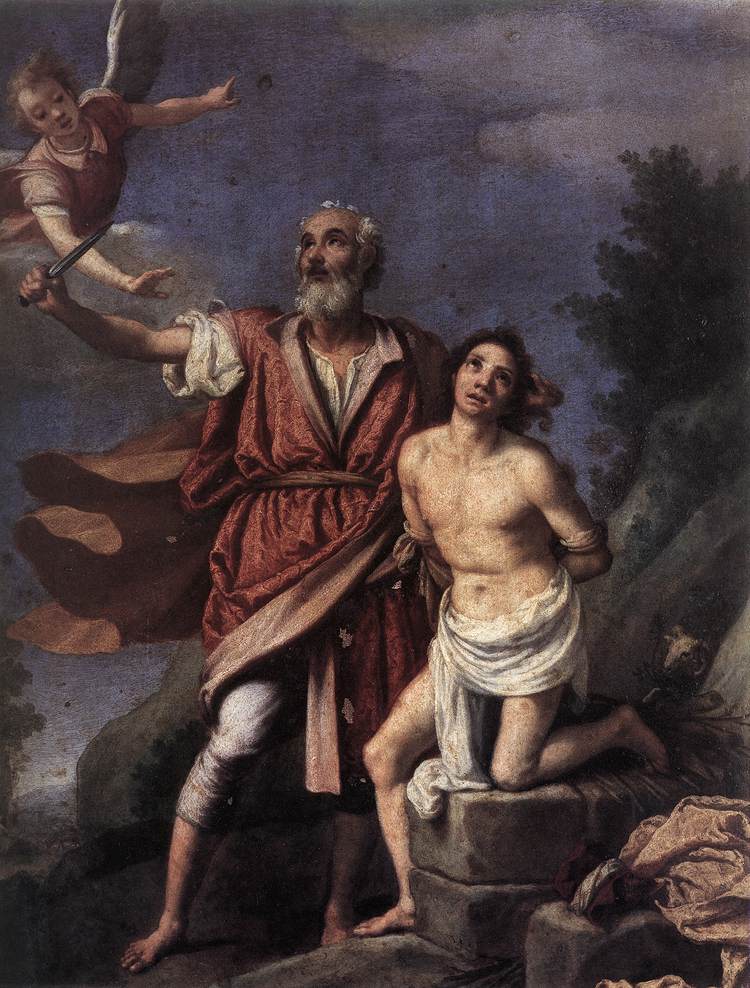
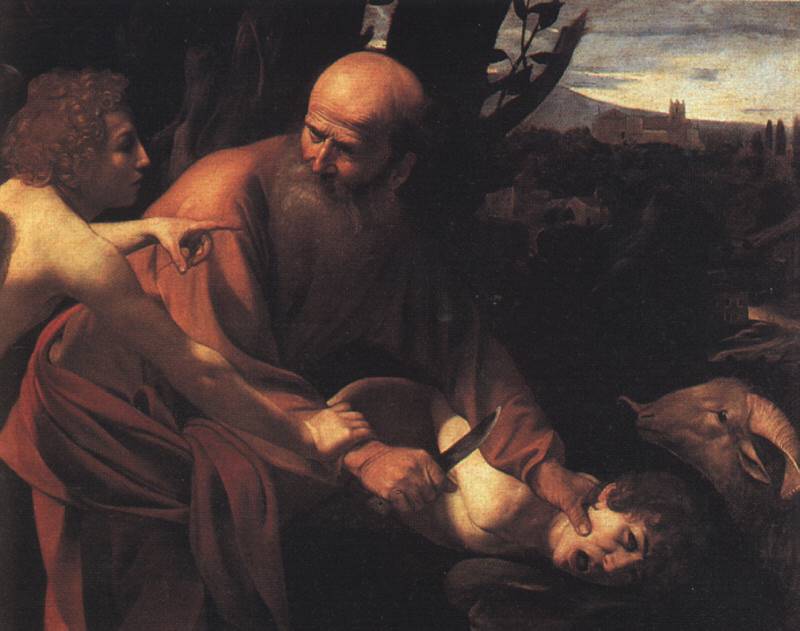
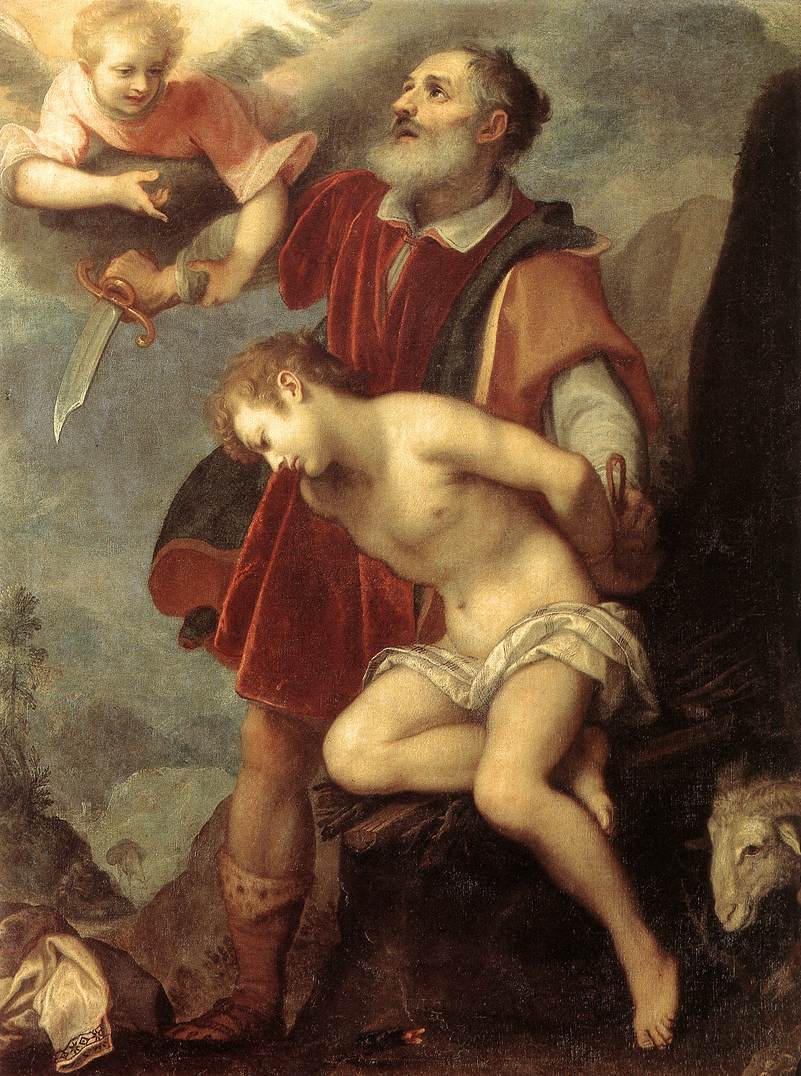
Paintings of Abraham and Isaac

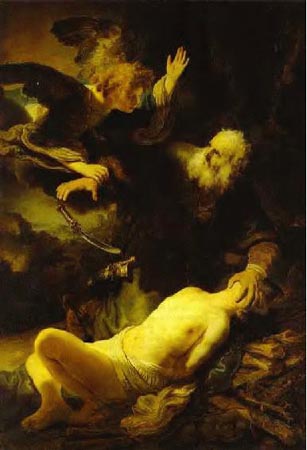
I recently preached on Romans 8:32 which says, “if God is for us, who can be against us. He who did not spare his own son, but delivered him up for us all, how shall He not also with Him freely give us all things?” The language “He who did not spare His own son” is a quote from the story of Genesis 22 where Abraham goes to Mount Moriah to offer his son Issac as an offering. Of Course, God stops Abraham, and says, “now I know that you fear me, because you have not spared your son, your only son Isaac whom you love.” Abraham did not spare his son Isaac, but God did. God sent a ram to be the sacrifice in the place of Isaac. In contrast that is not what God did for Jesus. There was no angel to call out and say “stop!” when Jesus was on the cross. God did not spare Jesus, so that he might spare us.

Anyway, that got me to thinking about this scenario and the way that artists have depicted the scene. You can find the Biblical account in Genesis 22.


Wikipedia
has a pretty good set of links for the art history of Abraham and Issac.

The Choosing of the 12 Apostles


Lessons from Jesus’ Choices

What is obvious about the 12 apostles of Jesus, is that the reason why they were chosen is not obvious. At least it is not obvious at first glance. If you were writing a book to advise people on how to start a religious movement that would turn the world upside down, you would certainly not make recommendations that your top leaders be of these kinds of men. The group lacks education, experience, wealth and influence. They are working class men, from different backgrounds, who possessed huge differences in their political and social affiliations. Why then did Jesus choose these men? We don’t know all everything behind the selecting of the 12, but I would suggest 4 reasons:

First, so that the glory would belong to God. When a self-sufficient person works hard and succeeds, the next step is usually taking responsibility for the accomplishments. If success was going to come from this group, no one would say, “Naturally, what did you expect from such a well qualified group.” This is exactly what happened in Acts 4:13 “Now when they saw the boldness of Peter and John, and perceived that they were uneducated and untrained men, they marveled. And they realized that they had been with Jesus.” Many times God goes out of his way to work through apparently fragile means, and weak people so that no one will steal the glory. In the Old Testament, God whittled down the army of Gideon to an astounding 300 soldiers in order to defeat the enemies of Israel. Why? “ And the LORD said to Gideon, ‘The people who are with you are too many for Me to give the Midianites into their hands, lest Israel claim glory for itself against Me, saying, My own hand has saved me. (Judges 7:2)’”

Second, I would suggest another reason these men were chosen: To show that grace unifies different people. Politically there could not have been two more polar opposites than a tax collector (a.k.a. Collaborator!) and a Jewish zealot. It is amazing that the tolerance and diversity that the world so desperately wants, is nowhere so typified as in the Church of Christ. Sure there is racism and division in the church. But find people that have really been transformed by the gospel and you will find a group who love people different than them. Grace shines bright when it overcomes the natural prejudices that we have towards others. The full realization of this will be in heaven, which will be more diverse than the United Nations, with people from every language and family on earth! When we unite around a common worthy focus, we show that the cause is more important than our differences.

Third, I believe that these men were chosen to show that usefulness is within reach of anyone. The Bible is an amazing book, it is painfully honest. Almost all of the accounts of the “heroes” of scripture are generously sprinkled with candid accounts of their failures. This is true of the apostles. Thomas who doubted; Peter who boasted, fought and then denied; James and John who sought glory for themselves. But the message of Jesus changed them. With these men and countless sinners since, God has shown that he can draw a straight line with a crooked stick. Jesus was able to see past failures and sins and see what His grace would accomplish in them.

Lastly, scripture teaches that God is opposed to the proud but gives grace to the humble. I would suggest that Jesus choose these men to shame the proud. I Corinthians 1:26-27 makes it very clear, “Brothers, think of what you were when you were called. Not many of you were wise by human standards; not many were influential; not many were of noble birth. But God chose the foolish things of the world to shame the wise; God chose the weak things of the world to shame the strong.” Christianity has not been the religion of the rich and the elite. It has been the faith of the weak and hopeless. By arranging things this way, God has brought down the gavel on those who trust in themselves that they are wise, or strong, or noble. By choosing servants like the apostles, and like us, he shows that his power is made perfect in weakness. We must rely on Him. I believe that this is one of the most important leadership lessons from the choosing of the 12 apostles.

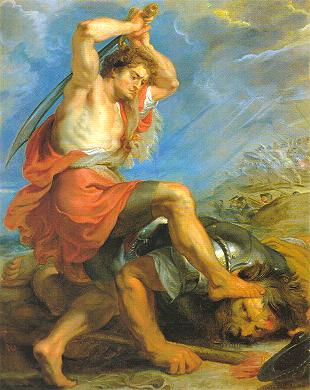
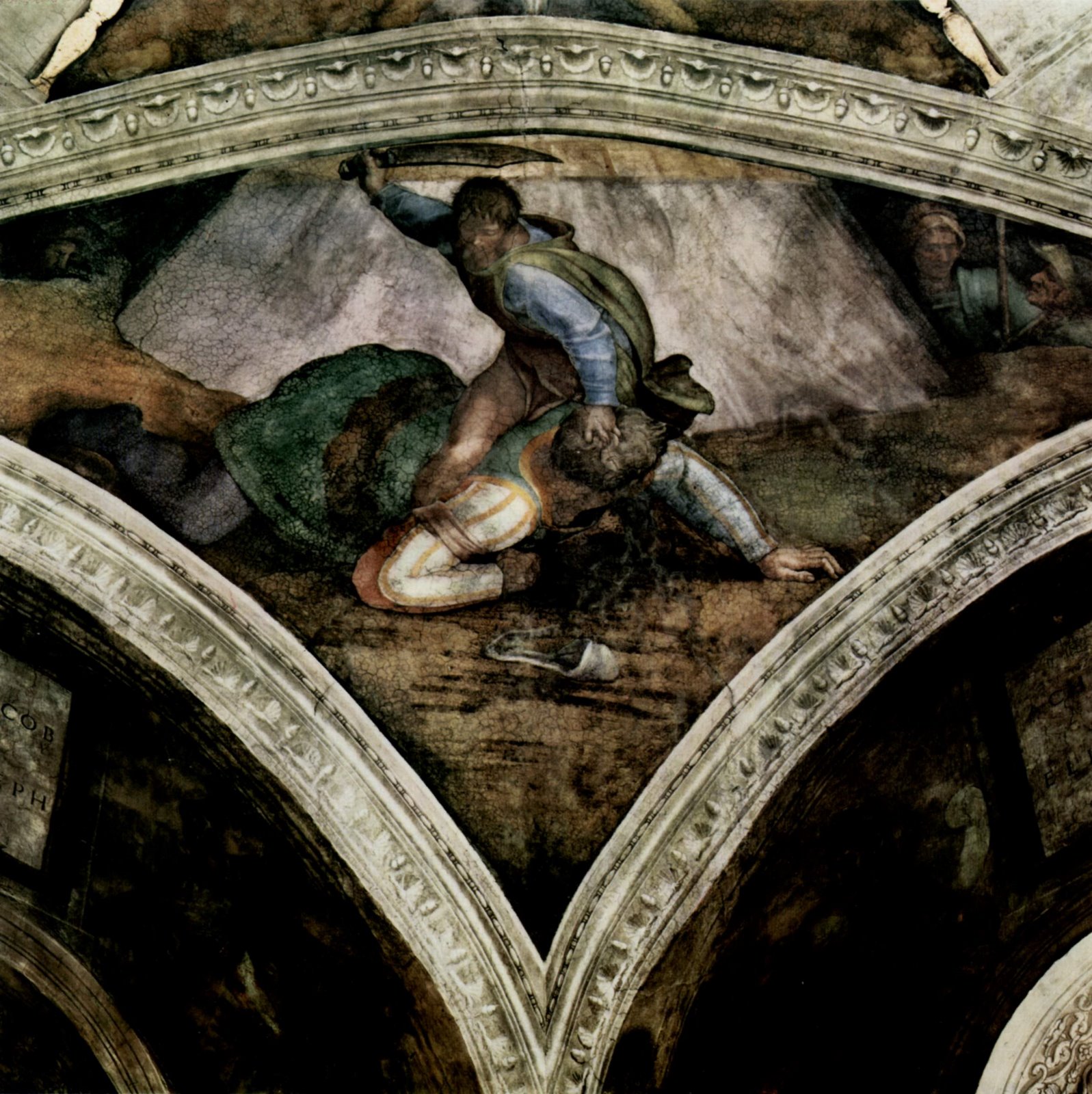
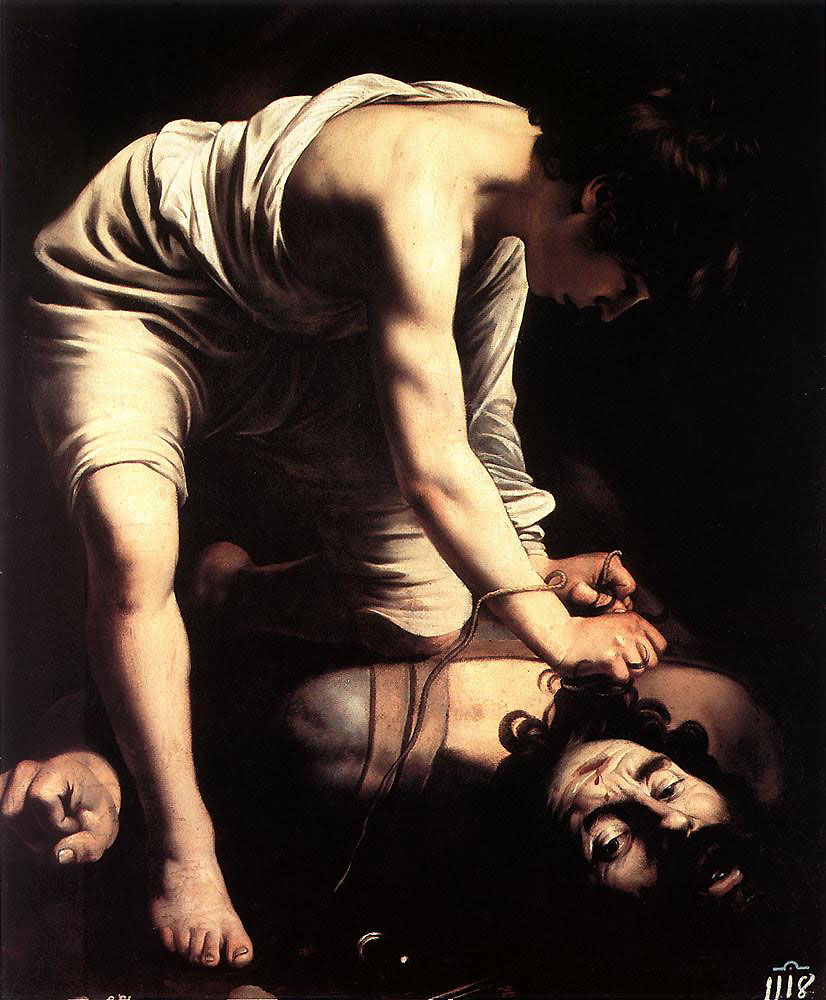
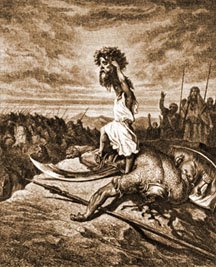
Paintings of David and Goliath

I am fascinated by the depictions of the account of David and Goliath in art. Here is a smattering of paintings from Reubens, Carvaggio, Michelangelo, and others. The story can be found in I Samuel 17.

I like the ones that accurately depict a young unsuspecting shepherd boy defeating a huge warrior. No Geneva Convention here!


Get More Out Of Reading the Bible

I have it from reliable sources that occasionally women will go shopping for clothes and spend several hours at a store, and try on clothes, and go to another store, and try on some more clothes, and then leave the store, and come home with nothing. This is puzzling to me…but the same thing often happens to me when I read my Bible. I read and read and finish, and come away with nothing.

A friend of mine-Mike Mills, also one of the most faithful Bible readers I know- put together this set of questions to make your window shopping in scripture a little more profitable. The idea is to spend time thinking about what you are reading and ask several questions that will help you nourish your soul. Here are the questions, I just put them in mnemonic form. According to my wife I am pathological about that 🙂 The pdf document is below. I am using this as a companion for my own Bible reading.

1. Is there a promise from God?
2. Is there an example to follow?
3. Is there a truth I am called to believe?
4. Is there a sin to confess?
5. Is there a command to obey?
6. Is there a new thought about God?
7. Is there an error to avoid?

Questions for Bible Reading PET CONE.pdf

http://www.box.net/static/flash/box_explorer.swf?widgetHash=mxomznp4w4&cl=0

A Poison Tree: Bitterness


This is a great poem, I always enjoy it…

A Poison Tree

I was angry with my friend:
I told my wrath, my wrath did end.
I was angry with my foe:
I told it not, my wrath did grow.

And I watered it in fears,
Night and morning with my tears;
And I sunned it with smiles,
And with soft deceitful wiles.

And it grew both day and night,
Till it bore an apple bright.
And my foe beheld it shine.
And he knew that it was mine,

And into my garden stole
When the night had veiled the pole;
In the morning glad I see
My foe outstretched beneath the tree.

William Blake

A Rhyme for the 12 Disciples

Ever have trouble memorizing the disciples? Here is way to lock it down:

“This is the way the disciples run

Peter, Andrew, James and John

Phillip and Bartholemew

Thomas next and Matthew, too.

James the less and Judas the greater

Simon the zealot and Judas the traitor.”

From Helen Gibbs

HOLD YOUR HORSES!!!!!

STOP RIGHT NOW!

Everything you have heard about evolution is a lie!!! in a new book, which I admit I haven’t read, but I did get a good chuckle out of the synopsis, Dr. Aaron G. Filler is going to set the record straight. For all of you who chucked your bible in the garbage because you believed that you descended from Apes, prepare for the shock of it all: you believed a lie!

There is now COMPELLING EVIDENCE, even more compelling that the indisputable evidence we had before, but threw away so we could sell more books, compelling evidence that things happened the other way around. APES ACTUALLY DESCENDED FROM US! This explains a lot, especially if you watch wrestling on TV.

I actually am not making this up. look for yourself on Amazon

I agree with Malcom Muggeridge who said that in the future a retrospecitve glance at evolution will view the whole thing as one of the great jokes of history.

Quote By Calvin on Unity Among Churches


No not that Calvin, the other one….

Calvin writes, “The pure ministry of the word and pure mode of celebrating the sacraments are, as we say, sufficient pledge and guarantee that we may safely embrace as church any society in which both these marks exist. The principle extends to the point that we must not reject it so long as it retains them, even if it otherwise swarms with many faults. What is more, some fault may creep into the administration of either doctrine or sacraments, but this ought not to estrange us from communion with the church. For not all articles of true doctrine are of the same sort (emphasis mine). Some are so necessary to know that they should be certain and unquestioned by all men as the principles of religion. Such are: God is one; Christ is God and the Son of God; our salvation rests in God’s mercy; and the like. Among the churches there are other articles of doctrine disputed which still do not break the unity of faith” (Institutes, 4:1:12; 2:1025).

4 Lessons for Teachers from Ezra 7:10

Ezra 7:10
“For Ezra had prepared his heart to seek the Law of the LORD, and to do it, and to teach statutes and ordinances in Israel.”

Ezra had just completed a 4 month journey from Babylon to Jerusalem. Verse 9 says that his journey was successful because God’s hand was upon him. Verse 10 gives an explanation of one of the reasons why God’s hand was on Ezra, his heart was right in God’s sight. “Every way of a man is right in his own eyes, But the LORD weighs the hearts (proverbs 21:2).” In this case, the Lord had searched Ezra’s heart and found it pure and sincere. What was pleasing to the Lord about Ezra as a teacher?

1. Ezra had made the study of God’s word a matter of the heart. When we grow in learning we may become proud. We may begin to think that our knowledge gives us privilege or some special standing. Knowledge is nothing if it doesn’t change our heart. The heart is our innermost being where motives, intentions, and goals arise. Jesus, quoting Isaiah, had condemned the Pharisees for their great learning and meticulous detail because their hearts were blackened, “these people draw near with their mouths And honor Me with their lips, But have removed their hearts far from Me (Isa. 29:13).” There is a word for people who study and teach the Bible without the involvement of their hearts: Hypocrit. This indictment was not true of Ezra. He drew near with his mind and his heart. Those who do not know the truth with their hearts do not really know it. And no one should teach the truth that doesn’t really know it.

2. Ezra’s approach was intentional. To put it another way, this focus on his heart was an active duty. He had prepared his heart. Focusing on our hearts in the study of the truth is the hardest thing of all. Our flesh resists. It is so much easier to learn the truth in order to win an argument or teach a lesson. But to preach the truth to your own heart is difficult. Why is it difficult? It involves seeing unpleasant things about ourselves. It also requires the humbling work of repentance when we see our sins. It requires that we see God’s word as a way to draw close to God Himself. We cannot do this in our own strength; we need God’s help. But this will never happen on accident, it must be the resolve of the heart. Lastly, the hard work of applying the truth to the heart is difficult because it is unseen. There are no bulging biceps, no certificates on the wall, no initials or letters to leave after your name, no pay raise. No one compliments you for it, because no one else sees it. It is one of the truest signs of real religion because it is done for God.

3. The study of the word, applied to the heart brought about certain results. The effect was obedience. Ezra was a doer of the word. What this means is that you would not need to say about Ezra, “do what he says but do not follow his example.” A careless life will sweep away the best teaching. Those who obey the truth through the many seasons of their lives have the best insight into what the word really means. Furthermore, teachers who are “doers” appeal to more than just the mind of their hearers. They are able to petition the heart. A life committed to God calls out to something inside the hearer, to something that looks at an orderly life and finds it attractive. A teacher who is a doer is a man who dresses up the gospel. The example of an obedient, happy life says that the obedience is not only right, it is beautiful; by grace it is possible by real people, and it is satisfying to the heart.

4. The last step in this description of Ezra is last for a reason. It comes after all these other things. It is unfortunate that so many want to put it sooner. They want to teach before the truth has affected their hearts, and their lives. They want to study and then teach. This can be done with many subjects…but not with the Law of God. Note as well that teaching God’s people was Ezra’s resolve and final goal. To be a faithful teacher to God’s people takes resolve and commitment, and should be done willingly.

Greg Bahnsen is Now on YouTube!!!

Though dead, yet he speaks! Some of his stuff is now available on Youtube for the world to see.
If you like rigorous thinking applied to Christianity and a critical analysis the unbleliever’s view of the world you will certainly benefit from his material.

He has lots of lectures available. I have enjoyed the debates, and his apologetics lectures. Here are some things I have learned:

  • That the Christan faith is not only rationally defensible, it is the foundation of rationality.
  • That unbeliever’s have plenty of faith assumptions that they cannot prove. They are often dishonest about this. Christians are also often guilty of intellectual dishonesty and it is our job to think clearly according to scripture.
  • That we have nothing to fear from the truth. God is the author of all truth and will vindicate himself.
  • There is a difference between proof and persuasion. You may present a sound argument for some position that is both valid and true. However, that does not mean that everyone is going to cry uncle. The heart is involved, not raw intellect.
  • Jesus is the source of all wisdom and knowledge.