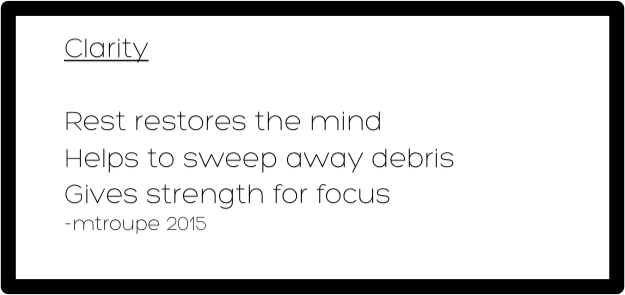
Monday Morning Haiku Springtime March 9, 2015

Haiku Dance Floor


More offerings for your enjoyment. Today is a sunny spring day with still enough cool to make pants enjoyable.

Dance Floor

Gentle breezes blow

Small twigs like a metronome

Shadows dance beneath

-mtroupe 2015


Resurrection

Even a dry spring

Wakens the blossoms to life

And tunes the bird songs

-mtroupe 2015


Disappointment

On a cool spring day

Distant lawn care machines roar

Drowning out the birds.

-mtroupe 2015

Stick It To The Patriarchy! Close The Snow Shoveling Gender Gap

It’s Time To Close The Snow Shoveling Gender Gap.

This is a funny piece from Mollie Hemingway at the Federalist.  It is funny because, well…. It’s funny.

What makes it funny is that she is not trying to be serious. It would be absurd to complain about this. Men should do more snow shoveling, because they are men.   But many of the other voices crying foul about “gender gaps” are trying to be serious. They are trying to manufacture some real outrage over imagined injustice.  There are actually people taking a stand against The Tyranny of the Home Cooked Meal (and a response here), and how a play like the Vagina Monologues oppresses all the women without vaginas. Yes, you read that last sentence correctly, “all the women without vaginas.”  It would be funny if it was a joke. But it isn’t. The sad thing about this stuff is it detracts from all of the real oppression of women out there. And there is a lot of it.

Snow shoveling is done disproportionately by men, and that this leads to dozens of heart attacks every year.  A burden that women should share, right?

Also, 92% of workplace deaths happen to men.  In part because men tend to work in more dangerous professions.

Some highlights:

“Every winter, about 100 people in the United States die shoveling snow, according to the BBC.

A study looking at data from 1990 to 2006 by researchers at the US Nationwide Children’s Hospital recorded 1,647 fatalities from cardiac-related injuries associated with shovelling snow. In Canada, these deaths make the news every winter.

And some more:

“This relates to another, far more serious, gender gap problem in workplace fatalities.

Screen Shot 2015-03-05 at 8.27.29 PM

That’s from the Bureau of Labor Statistics at the Department of Labor. Males work 57 percent of the hours worked but suffer from a whopping 92% of the workplace deaths. Time for some equality of death, no?”

Essentialism Questions Ch. 3

You can download a journal-friendly version of the questions here: Essentialism Questions Ch. 3

This is a list of discussion questions to help work through the content of the book “Essentialism” By Greg McKeown. Why discussion questions? Because interacting with the material and thinking through how the principles apply in your own circumstances is more likely to produce real learning and lasting change.

Major principles:

Most things that occupy our time are NOT important. They are a part of the “trivial many” vs the “vital few.”

Key examples/illustrations

  • Boxer the Horse from Orwell’s Animal Farm
  • The difference in hourly rates for different jobs
  • El Bulli Restaurant
  • The Pareto Principle and the “vital few”
  • Warren Buffet’s investing strategy

T

Power Law graph from Forbes

  1. The chapter opens with a quote from Richard Koch, author of several books on the 80/20 (or Pareto) principle: “MOST OF WHAT EXISTS IN THE UNIVERSE— OUR ACTIONS, AND ALL OTHER FORCES, RESOURCES, AND IDEAS— HAS LITTLE VALUE AND YIELDS LITTLE RESULT; ON THE OTHER HAND, A FEW THINGS WORK FANTASTICALLY WELL AND HAVE TREMENDOUS IMPACT.”  This idea can seem at odds with common sense. Do you agree with Koch? If so why? If you are having trouble accepting this idea, why?
  2. McKeown mentions the story of Animal Farm and the horse “Boxer” who’s answer is to every problem is to work harder. Based on the ideas in this chapter what are the possible outcomes of such a strategy?
  3. Why are there limits to the value of “working harder?”
  4. Some types of effort yield more and better results than other kinds of effort.  Have you experienced this in your life before?
  5. What makes something essential or important for you? Make a very short list of what makes something truly important or vital to your life.
  6. Which activities are you spending your time on that are low yield? Which are high yield? Put another way, which activities are minimum wage or less for you? Which produce the greatest results in terms of money, outcomes, happiness, quality, etc.?
  7. After a certain amount of time, “working more, working harder” results in a plateau of productivity.  This can happen because of exhaustion, loss of resources, discouragement, mental fatigue, etc.  Are there any areas in your life where you are seeing a plateau of results? Do the hard work of being honest with yourself.
  8. Diversification is a common strategy for investors. Yet according to “The Tao of Warren Buffett,” billionaire Warren Buffet makes 90% of his money of just 10 investments. What factors drive the emphasis on diversification rather than focus? Where do you see these factors at work in your life?
  9. Take a moment to look up “power law theory.” You can do a brief search, or here is an example of a write up from Forbes. A power law distribution is very different from a normal “bell curve.”  This distribution shows some of the science behind the big idea in this chapter. Some people/ideas are far more influential than others.  What is your major impression from the power law theory? Take a moment to write this down.
  10. Power law theory demonstrates that most “inputs” (people, products, sales accounts, ideas, activities) in the tail fall below median. They do NOT yield average results, they produce below average results. What activities in your life are in the long tail, bringing you lower-than-average results? How can you exchange them? Which one can you quit this week?
  11. Talking about high performing employees, Mark Zuckerberg said, “Someone who is exceptional in their role is not just a little better than someone who is pretty good. They are 100 times better.” This is not only true of people, it is true in many areas of life. Which things might you do that are even 10x more effective than the “pretty good” activities that take up most of your time.
  12. Most people fail to become essentialists because they don’t know the difference between important vs unimportant.  How can you learn  the difference in your own life?
  13. Does it seem insulting or distasteful to say that most things are “unimportant?” Why?
  14. Marketers work hard to convince people that their products/services are important. Part of their success comes from the fact that their audience hasn’t decided ahead of time what is truly important.  This can lead to people constantly looking for success through purchasing a new product or software, changing to the newest and hottest business strategy, reading another self help book. Where do you see yourself influenced about what is important by outsiders?
  15. McKeown recommends that in light of these principles we spend ample time considering what is truly essential. Take time right now to make an appointment with yourself every week for reflection on your schedule and activities.


Monday Morning Haiku on Rest

haiku-logo

More amateur poetry offerings.  In the last year I have been writing more haiku. Today I am taking a day off and wrestling with the benefits and difficulties of rest when it is both needed and difficult. I am a workaholic and have been learning that rest is a form of both worship and repentance. It is a way to confess that I am not God,  and that it doesn’t all depend on me. It is also a way to express my trust that he will take care of “business” while I enjoy some time of restoration. Enjoy.

Haiku_rest_3_1_15_pages_pdf__1_page_


Haiku_rest_3_1_15_pages_pdf__1_page__1


Haiku_rest_3_1_15_pages_pdf__1_page__2


Jesus Friend of Sinners

Rabbi friends

I was recently invited to give a devotional at a pastor’s meeting where we discussing outreach and the importance of loving our neighbors.  The general text of my talk is below:

Luke 5:27-32

27 After this he went out and saw a tax collector named Levi, sitting at the tax booth. And he said to him, “Follow me.” 28 And leaving everything, he rose and followed him. 

29 And Levi made him a great feast in his house, and there was a large company of tax collectors and others reclining at table with them. 30 And the Pharisees and their scribes grumbled at his disciples, saying, “Why do you eat and drink with tax collectors and sinners?” 31 And Jesus answered them, “Those who are well have no need of a physician, but those who are sick. 32 I have not come to call the righteous but sinners to repentance.” (ESV Bible Translation)

In this passage, we see that Jesus has rescued Levi… one of the worst kinds of men, he was a tax collector. He was most likely a Jewish man, probably from the tribe of the priests. He should have been receiving tithes to fund worship in the house of God, instead he is a traitor… taking taxes to give to the Romans.  And most tax collectors also committed extortion.

But Levi has come to follow Jesus.  And he will become one of the most of the most influential men in the history of the church. He is the apostle Matthew. We still read his gospel.  This is what Jesus Christ does, he takes the people that we look down on, people that are hopelessly corrupt and despised… and He saves them and gives them a great calling. He makes them sons and servants of God. This should give us hope. God might even use someone like you!

After Levi comes to follow Jesus, he is so overjoyed with his new relationship with Christ that he throws a party. He wants all of his friends to meet this Rabbi that is different than any other rabbi… Let me say this, the only way the people in our churches will ever do anything like this, is if they are so amazed and thrilled with Jesus Christ that he is their treasure.

So, Jesus is eating and drinking with tax collectors, and “Sinners.” And the Pharisees protest, they ask the question in v. 30, “Why are you doing this?”  Jesus is so close, and so friendly, with these awful people, there can only be one reason.  He must be supporting them in their sin.

Jesus answers with his own mission statement in v. 32. He is like a doctor that came to help the sick. He didn’t come to help healthy people, but the lost and broken.

I would like to suggest that the Pharisees don’t really have a problem with WHAT Jesus is doing. The idea of telling these dirty sinners that they need to repent is probably OK with them. If he stood on the street and yelled at them, they would probably stand and cheer. No, Their problem is with HOW he is doing it.  How is Jesus calling them to repentance? By eating and drinking with them. He has become friends with them, and through friendship calling them back to fellowship with God. His actions are a living parable of the message of the gospel. God makes his enemies to become his friends.

This doesn’t fit very nicely into our box does it!  In many places in the church people live at the far ends of the spectrum.

Some embrace the lost and “sinners” by becoming friends with them. They want to love and support them, but they don’t offer them any medicine.  In fact, they think that if you suggest that people are spiritually “sick”, then you must be judgmental.

On the other end there are Christians that want to call people to repentance, but they do it from a safe distance. They want to do it the way we are fighting terrorists, with drones. They do it by tract bombing, or doing “outreach” twice a year. They want to do it from a place of moral superiority. They are concerned that getting too close to lost people might get them dirty or damage their reputation.  Though I have probably been guilty of both extremes, I think this second one is far more common among serious christians.

But Jesus does something different, he is able to receive and love people without endorsing or participating in their vices and sins. And he is able to call them to repentance, without alienating them or withdrawing from their company.

Brothers and sisters, this is our great salvation and our great example. And we will never be able to do this if we think we are the healthy and righteous ones. We will only be able to do this when we see that we are the sinners he came to call. When we see ourselves like Levi, completely beyond hope. But thrilled that we have a place at the table- that we have been loved and received by Grace.


Photo used courtesy of the University of Washington. 

Argumentative People are Dangerous People

Boxer

There is a difference between having an argument and being an argumentative person.

There are times when we need to “argue” and even “fight” for the truth or an important idea.  But there is a difference between having an argument and being an argumentative person.  In Jude 3 we read, Beloved, although I was very eager to write to you about our common salvation, I found it necessary to write appealing to you to contend for the faith that was once for all delivered to the saints.”  Jude’s readers were under attack by people that were distorting the gospel of Jesus.  There was a need to fight for the truth, and that is what motivated him to write. Unfortunately, some folks take passages like this as  permission, or even a mandate to fight.  About anything and everything. And this has never been more apparent than during the age of social media.

There will always be enemies to battle.  But the argumentative person has a polarizing effect. They can turn every conversation into a debate and every person into a potential enemy.   In the margin of my Bible at the end of  the book of Titus, I have a list of these passages that all have to do with the problem of being an quarrelsome person.  They are listed below (ESV) with some observations.

I Tim 1:4, 6-7  “…nor to devote themselves to myths and endless genealogies, which promote speculations rather than the stewardship from God that is by faith… Certain persons, by swerving from these, have wandered away into vain discussion, desiring to be teachers of the law, without understanding either what they are saying or the things about which they make confident assertions.”

This passage strikes me because it points to the danger of speculations. There are some things in scripture that are really clear and really important.  But other things are less clear.  Many Christian movements and denominations are based on speculation.  People fight about the implications of Bible texts, and about the implications of implications.  And strangely the people that know the least about a subject are the quickest to voice their opinion. It has been said, “more heresy is preached in application than exegesis.”  How true. Controversy is more common and more damaging when we wander away from things that are clearest.

I Tim 2:8 “I desire then that in every place the men should pray, lifting holy hands without anger or quarreling.

We cannot come to God rightly if we have ongoing problems with our brothers and sisters. Unfortunately, frequent arguments and debates lead to anger and fractured fellowship. It prevents us from entering into prayer the way He intends.

The argumentative person can turn every conversation into a debate and every person into a potential enemy.

I Tim 6:3-5 “If anyone teaches a different doctrine and does not agree with the sound words of our Lord Jesus Christ and the teaching that accords with godliness, he is puffed up with conceit and understands nothing. He has an unhealthy craving for controversy and for quarrels about words, which produce envy, dissension, slander, evil suspicions, and constant friction among people who are depraved in mind and deprived of the truth, imagining that godliness is a means of gain.”

Some people crave controversy. This is NOT a virtue.  And these kinds of people love to argue about words. Of course words are important. But these kind of people see words as opportunities to act like lawyers looking for loopholes.  What is startling about this passage is how it describes the fruit of quarreling, “envy, dissension, slander, evil suspicions, and constant friction.”  All of the works of the flesh thrive in the atmosphere of controversy.

2 Tim 2:14-16 “Remind them of these things, and charge them before God not to quarrel about words, which does no good, but only ruins the hearers. 15 Do your best to present yourself to God as one approved, a worker who has no need to be ashamed, rightly handling the word of truth. 16 But avoid irreverent babble, for it will lead people into more and more ungodliness.”

Here we are actually commanded not to argue. And the reason is all the nasty fruit: The “ruin of the hearers,” and “more and more ungodliness.”  An approach to Christianity that is constantly fighting destroys people, and leads to nothing good.  Passages like this should make us pause before entering the fray and ask if it is really worth it.  Being a brawler is not an innocent pastime.

2 Tim 2:24-25 “And the Lord’s servant must not be quarrelsome but kind to everyone, able to teach, patiently enduring evil, 25 correcting his opponents with gentleness. God may perhaps grant them repentance leading to a knowledge of the truth.”

Here Paul is clear that those in ministry shouldn’t be quarrelsome.  And when they do need to step into an argument they need to do with patience and gentleness.  The intent should always be constructive, one of love and hope for the other person. The desire to destroy others is in conflict is desperately evil.

Titus 3:2, 9-10 “speak evil of no one, to avoid quarreling, to be gentle, and to show perfect courtesy toward all people…But avoid foolish controversies, genealogies, dissensions, and quarrels about the law, for they are unprofitable and worthless. 10 As for a person who stirs up division, after warning him once and then twice, have nothing more to do with him.”

Sadly arguments often lead to insults and rudeness.  We move from arguing for the truth, to verbally attacking people.  In the process we lose track of courtesy.  We are to avoid these kinds of controversies. Some things are not worth arguing over because there is little to be gained. They are “unprofitable and worthless.” This is one of the few times in the Bible we are told to avoid people.   “I’m sorry I can’t be around you, you are a trouble maker.”

Tim Keller wrote a helpful series on this called, “Gospel Polemics.”  You can find it here.

Photo courtesy of the Museum of Hartlepool

Who Am I? My Identity Creed

selfie mirror

One of the deepest questions of human experience is this: “Who am I?”  And this question seems more urgent for our generation as we tumble into the abyss of self definition.  Is there anything that I “objectively” am.  And I mean this as a human, and especially as a Christian?  And is this something I need to create or to recognize?

How can we wrestle with the contradiction that we are? How can we honestly embrace the innate virtue and vice that is humanity?

It seems that everyone is trying to sell us a story for this. And it is hard to take the answers seriously when they come from marketers, politicians, and angry preachers. On one side are the cheerleaders telling us how amazing everything is.  If I could just recognize my inner superhero, euphoria awaits! On the other side you have the misanthropes that can only see the evil and injustice of humanity.  They downplay the obvious value and virtue we see in the world.  Both sides see something important, and simultaneously miss something obvious.  How can we wrestle with the contradiction that we are? How can we honestly embrace the innate virtue and vice that is humanity?  My answer below comes from Christ and what he has done for me.

  • I am a unique human being designed by a wise and powerful creator. I am not merely an animal. Like every human I have an eternal soul. I have value and dignity because I am made in the image of God. I was made to be like him in goodness and creativity. I have the ability to love and be loved by God and others.
    • I am a fallen person. I have turned my back on God and chosen to break the laws he gave for my good.  Sin has affected every part of my body, soul and mind. I was designed by God for good, but on my own I do not have the strength or will to do his good purpose.  I am now broken by guilt and shame. My natural tendency is selfishness. My attempts to fix myself often make things worse.
    • I am now a redeemed child of God. I am not what I once was. Jesus took my nature so that he might die for me and be raised from the dead. I am loved and forgiven because of the work of Christ, and his Holy Spirit lives in me. I have confessed my sins and returned to God.  I have been made righteous in Christ, and though I battle with sin, his grace is at work in me to restore my soul. I am now part of the body of Christ, and my fellowship with God has been restored.
    • Though I struggle, my faith in his promise assures me that he will complete the work he has begun in me.  He is daily renewing me and I am slowly growing to maturity.  Through Jesus my sincere love and faith please God. One day he will completely renew me and all things. And though my body is still decaying, I look forward to the day when I will be with him forever. He is making me more like Christ. In this joy and hope I live and serve.

Photo Used By Permission Jonathan Lidbeck. Some Rights Reserved

Speed Kills- Why The Pressure to Go Faster Is Eating Our Souls

Speed Kills – The Chronicle Review – The Chronicle of Higher Education.

Sometimes you read an article that powerfully says something you were already thinking, but had trouble putting into words.  This is one of those articles for me.  I am admittedly addicted to the same craving for speed that afflicts the rest of us. But more and more I am feeling cheated. I am feeling like I want to raise a protest. I want to “stick it to the man” that keeps yelling “SCHNELL!”

Mark Taylor has done a good job showing the deleterious effects of a lust for “more and more, faster and faster” on several dimension of our culture. He specifically discusses the impact on capital markets, communication, and education.

“The faster we go, the less time we seem to have. As our lives speed up, stress increases, and anxiety trickles down from managers to workers, and parents to children.”

Our ability to do things faster has had exactly the opposite effect that thinkers and politicians predicted.  We thought that being able to finish a job sooner would allow us to clock out and go home. That we would now have time for recreation, art, and family. Nope. Instead, “Contrary to expectation, the technologies that were supposed to liberate us now enslave us.”  He writes:

“With the emergence of personal computers and other digital devices in the late 1960s and early 1970s, many analysts predicted a new age in which people would be drawn together in a “global village,” where they would be freed from many of the burdens of work and would have ample leisure time to pursue their interests. That was not merely the dream of misty-eyed idealists but was also the prognosis of sober scientists and policy makers. In 1956, Richard Nixon predicted a four-day workweek, and almost a decade later a Senate subcommittee heard expert testimony that by 2000, Americans would be working only 14 hours a week.”

The quest for speed has been paired with our desire to measure success with numbers. This has destroyed or dismissed hard-to-count virtues like creativity, reflection, and problem solving. And Oh, yeah, what about happiness?  There is a difference between “rapid information processing,” the kind of thing we do when reading and writing online, and “slow, careful, deliberate reflection.”  By the way, when was the last time you read anything about “slow, careful, deliberate reflection.”   Yeah, me too.  Probably in too much of a hurry.  We are too busy to ask whether our pace is actually good for us.

By the way, when was the last time you read anything about “slow, careful, deliberate reflection.”

One of the other bad effects of speed is that it tends to diminish complexity in favor of simplicity. Now, simplicity is a good thing. But not everything is simple. And paradoxically, arriving at the kind of simplicity that is truly valuable takes a LOT of time. Greg McKeown has argued for this in his book Essentialism.  If you are going to figure out what is truly important you will need time and space to do it.

Life is moving too fast, and we are NOT better off because of it. Read this article and take another step toward deliberately slowing down.

The Mixed Story of Racism: A Black Judge’s Sentencing Speech to 3 White Murderers

U.S. District Judge Carlton W. Reeves, for the Southern District of Mississippi. Courtesy of cleoinc.org


A Black Mississippi Judge’s Breathtaking Speech To 3 White Murderers : Code Switch : NPR.

Wow.

This is worth your time to read. 3 white men in Mississippi were sentenced for the brutal and racially motivated killing of 48 year old James Anderson.  These men were involved in an escalating pattern of violence that echoes the “ni&&er hunts” that have punctuated this state’s past.  Beware the article does use the “N” word a number of times in reflecting on the evils of racism and the troubled history of that state.

“In Without Sanctuary, historian Leon Litwack writes that between 1882 and 1968 an estimated 4,742 blacks met their deaths at the hands of lynch mobs”

According to the judge, these acts were committed by young men who were described by others, ‘as “a fine young man,” “a caring person,” “a well mannered man” who is truly remorseful and wants to move on with his life … a very respectful … a good man … a good person … a lovable, kindhearted teddy bear who stands in front of bullies…’  The men were incriminated by video evidence and their own guilty pleas.

The events themselves reveal that there is more need for progress.  The end of the speech shows that change has been on the march and this is encouraging.  There is a satisfying irony in this, that only enhances the justice of the proceedings.

“Today, though, the criminal justice system (state and federal) has proceeded methodically, patiently and deliberately seeking justice. Today we learned the identities of the persons unknown … they stand here publicly today. The sadness of this day also has an element of irony to it: Each defendant was escorted into court by agents of an African-American United States Marshal, having been prosecuted by a team of lawyers which includes an African-American AUSA from an office headed by an African-American U.S. attorney — all under the direction of an African-American attorney general, for sentencing before a judge who is African-American, whose final act will be to turn over the care and custody of these individuals to the BOP [Federal Bureau of Prisons] — an agency headed by an African-American.

“Today we take another step away from Mississippi’s tortured past … we move farther away from the abyss.”


Fifty Shades of Grey: Pornography and Normalizing the Bizarre

Fifty Shades of Grey: Pornography and Normalizing the Bizarre | Canon and Culture.

Bart Barber has done a good job of going beyond “rules” while discussing 50 Shades of Grey.  When asking the question whether anyone, and especially Christians, should see this movie we need beyond a simple rule-based evaluation. We need to see what is behind the best rules.  God has given us a world full of truth, beauty and goodness.  And this includes sexuality. We cannot abandon beauty without loosing goodness.  The article is worth reading.

I haven’t seen the movie or read the book, and I plan on NOT doing either. But from what I have read about the content, I am absolutely perplexed how a culture obsessed with talking about the abuse of women can make this a bestseller.

“This is the true price of pornography. Yes, pornography normalizes the bizarre, but the flipside of the coin may be the darkest aspect of it at all: It bizarrifies the normal.”

A few highlights:

“This is the true price of pornography. Yes, pornography normalizes the bizarre, but the flipside of the coin may be the darkest aspect of it at all: It bizarrifies the normal. If one were to create a pornographic website that featured average couples who had been married twenty years or more engaging in sex as the average married couple experiences it, who would watch it? And yet study after study has shown that the greatest satisfaction in romance comes to people in just that kind of a relationship. There is beauty there; our culture just doesn’t condition us to see it. What would we see if married men and women described their marriages to a sketch artist? What would we see if their friends described their marriages? When it comes to beauty, something about us has gone wrong.”

“Are you open to seeing this in another way? Each time you choose to read a book, choose to watch a film, or choose to DVR a television show, you are revealing something about what you find to be beautiful. Rather than imposing a set of shackles, God is trying to free you to crawl out of the muck and mire and to learn beauty.”