
God Loves Me & So Does My Dog, But It’s Different

God Loves Me,And So Does My Dog. But 2

I have a 1-year old chocolate colored poodle. She’s a great dog and she’s always happy to see me. Wait, that’s an understatement. She goes nuts when we come home.  She is so excited that often she wets herself.  We feed her, and pet her.  We take her for walks occasionally. We play with her and hang out together. And that’s enough, she thinks we are wonderful.  She jumps on the bed in the morning and licks my face to wake me up. She always wants to play. And even when we aren’t playing she just wants to be near me. She follows us around the house and lays at my feet.  And all her enthusiasm and love is great for my self-esteem.  And she does this even when we ignore her. Sometimes we have to lock her up in a crate for most of the day to keep her from destroying the house. But when we come home and let her out, it’s a celebration.

For some Christians, this is a close description of how they understand God’s love.  He is really excited about us, makes hardly any demands, and won’t mind if we lock him away in a crate when we have better things to do. They have attempted to tame God, and as a result his love is… Well… Just okay.  But it doesn’t match the love we see at Calvary where we see Christ pouring out his life for an unfaithful spouse.   The puppy-dog  kind of love doesn’t produce the (seemingly) irrational joy, worship, and sacrifice we see described in scripture.  It doesn’t buoy up the soul in the face of great sin and suffering.

I am slowly working my way through “Yawning At Tigers” by Drew Dyck. He writes about this phenomenon, and our tendency to domesticate God.  Writing about modern preachers, he says:

“Unfortunately, in our efforts to make the Bible interesting and relevant, we try to normalize God. We become experts at taking something lofty, so unfathomable and incomprehensible, and dragging it down to the lowest shelf. We fail to account for the fact that God is neither completely knowable nor remotely manageable”

Unfortunately, in our efforts to make the Bible interesting and relevant, we try to normalize God.

He says that we are often uncomfortable with the mysterious, and transcendent descriptions of God. They are too strange or even unpleasant to our American sensibilities, so we explain them away.  Again, he writes “Here’s the beautiful irony: making God strange actually enables us to know him more. Once we have marveled at his magnitude and mystery, we are able to achieve the deep intimacy that grows out of a true appreciation for who God is. Instead of treating him as an equal, we approach him with reverent awe. Only when we’ve been awestruck by his majesty can we be overwhelmed by his love.”

I love my dog, and enjoy the way she worships me. And that would be the best word to describe it!  But God’s love is different, it’s not about his infatuation with my greatness.  One of the reasons we are “yawning at tigers” is because we are not impressed with the love of God. And we are underwhelmed with his love because we don’t understand his holiness, majesty, and greatness. If we did, we would understand our own sin as well and see just how much it cost him to love us.  And that would make his love something to live for.

Monday Morning Haiku on Rest

haiku-logo

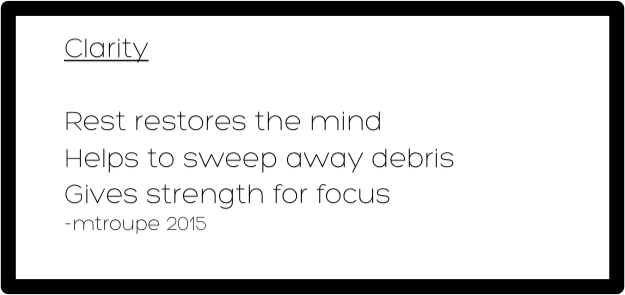
More amateur poetry offerings.  In the last year I have been writing more haiku. Today I am taking a day off and wrestling with the benefits and difficulties of rest when it is both needed and difficult. I am a workaholic and have been learning that rest is a form of both worship and repentance. It is a way to confess that I am not God,  and that it doesn’t all depend on me. It is also a way to express my trust that he will take care of “business” while I enjoy some time of restoration. Enjoy.

Haiku_rest_3_1_15_pages_pdf__1_page_


Haiku_rest_3_1_15_pages_pdf__1_page__1


Haiku_rest_3_1_15_pages_pdf__1_page__2


Who Am I? My Identity Creed

selfie mirror

One of the deepest questions of human experience is this: “Who am I?”  And this question seems more urgent for our generation as we tumble into the abyss of self definition.  Is there anything that I “objectively” am.  And I mean this as a human, and especially as a Christian?  And is this something I need to create or to recognize?

How can we wrestle with the contradiction that we are? How can we honestly embrace the innate virtue and vice that is humanity?

It seems that everyone is trying to sell us a story for this. And it is hard to take the answers seriously when they come from marketers, politicians, and angry preachers. On one side are the cheerleaders telling us how amazing everything is.  If I could just recognize my inner superhero, euphoria awaits! On the other side you have the misanthropes that can only see the evil and injustice of humanity.  They downplay the obvious value and virtue we see in the world.  Both sides see something important, and simultaneously miss something obvious.  How can we wrestle with the contradiction that we are? How can we honestly embrace the innate virtue and vice that is humanity?  My answer below comes from Christ and what he has done for me.

  • I am a unique human being designed by a wise and powerful creator. I am not merely an animal. Like every human I have an eternal soul. I have value and dignity because I am made in the image of God. I was made to be like him in goodness and creativity. I have the ability to love and be loved by God and others.
    • I am a fallen person. I have turned my back on God and chosen to break the laws he gave for my good.  Sin has affected every part of my body, soul and mind. I was designed by God for good, but on my own I do not have the strength or will to do his good purpose.  I am now broken by guilt and shame. My natural tendency is selfishness. My attempts to fix myself often make things worse.
    • I am now a redeemed child of God. I am not what I once was. Jesus took my nature so that he might die for me and be raised from the dead. I am loved and forgiven because of the work of Christ, and his Holy Spirit lives in me. I have confessed my sins and returned to God.  I have been made righteous in Christ, and though I battle with sin, his grace is at work in me to restore my soul. I am now part of the body of Christ, and my fellowship with God has been restored.
    • Though I struggle, my faith in his promise assures me that he will complete the work he has begun in me.  He is daily renewing me and I am slowly growing to maturity.  Through Jesus my sincere love and faith please God. One day he will completely renew me and all things. And though my body is still decaying, I look forward to the day when I will be with him forever. He is making me more like Christ. In this joy and hope I live and serve.

Photo Used By Permission Jonathan Lidbeck. Some Rights Reserved

Absolute Goodness

Beware

“God is the only comfort, He is also the supreme terror: the thing we most need and the thing we most want to hide from. He is our only possible ally, and we have made ourselves His enemies. Some people talk as if meeting the gaze of absolute goodness would be fun. They need to think again. They are still only playing with religion. Goodness is either the great safety or the great danger—according to the way you react to it. And we have reacted the wrong way.”

CS Lewis, Mere Christianity


Photo Courtesy of James Quinn. Some rights reserved.

Seeing the Beauty of Christ Through Brokeness: Book Review


Beauty Brokenness

This is a short book (I read it in one day, a little more than an hour- I guess that makes it a booklet) and for only .99 on Kindle you can’t beat it. I would recommend the book to add to your perspective on pride, humility and suffering.

It is full of some golden observations on the need for humility in the Christian life, and especially in ministry. It speaks a note that is frequently missing, and one we would rather not face.  We would all like success without the pain of failure, suffering, and self-denial. But God uses these important teaching lessons to bring us the greatest joy and greatest usefulness. I love the emphasis in this book on the importance of character and humility over the value of personal skills and gifts.  The book is full of practical stories that flesh out his ideas, and these are helpful. He is also honest about his own pride and struggles and reveals how the Lord has humbled him. That is a rare trait as a leader. It makes me want to meet him!

I am a little at a loss about the title. The book isn’t really about the beauty of Christ. It is more like the value of brokenness as a prerequisite to usefulness in ministry. At least that was my perception.  I think this is important, because one of the most valuable things that happens in suffering is that the Lord is stripping away all of our false trusts in order to show us why Jesus Christ is better than those trusts.  There are hints of this in the book, but not as much about the beauty of Christ as I expected. It is possible to be stripped down and not be strengthened in Christ, and that is not at all a valuable thing. I am pretty sure the author would agree with me on this.

At a number of points he makes some statements that I disagree with, and those may reflect his theological perspective. I am not sure what his background is, so I can’t comment. But his emphasis on free will and talk about what God “cannot” do made me pause at several points. Also, the way he suggests that Jesus needed to be broken seems strange to me,  Jesus submitted to the cross because of our sin not because of any lack in himself.  His death is an example and a patter for us, but our need to be broken is because of our sin and self sufficiency.  His need to be broken was because we aren’t what we ought to be.

There is also an emphasis on our need to choose to be broken that seems to leave out an the miraculous movement of God to change the heart through the Holy Spirit apart from our permission.  Or perhaps I should say, that we come to the point of giving our permission because his grace has changed us, and only because of that miracle.  Of course he uses suffering as one of his tools, but he also uses the Holy Spirit blessing the word of God. There are many people that suffer and are still never broken. Others suffer and become humble and teachable. The difference is more than the will of man, it is the miraculous grace of God. Otherwise I could say that I am humble because of my choice and he is proud because he failed to make the choice that I made.

In spite of my reservations theologically, the book still has a lot of value. Thank you to the author  for writing and sharing your experience.

What is the Bible All About?

I just came across this great book, which was previously a series of lectures by DA Carson called “The God Who is There.” I am not sure if this is a title connection between Francis Schaeffer’s famous book. Anyway, the idea is to take a jet tour of the big story of the Bible in 14 lectures. Carson is a very learned, clear, and informed communicator and these talks are good! I have been challenged and refreshed. Best of all the talks are intended to be accessible to people who do not have a lot of previous bible knowledge.

Here is the first talk:

The God Who Is There – Part 1. The God Who Made Everything from The Gospel Coalition on Vimeo.

Dealing With The Accuser

“Satan accuses Christians day and night. It is not just that he will work on our conscience to make us feel as dirty, guilty, defeated, destroyed, weak, and ugly as he possibly can; it is something worse: his entire play in the past is to accuse us before God day and night, bringing charges against us that we know we can never answer before the majesty of God’s holiness.

What can we say in response? Will our defense be, ‘Oh, I’m not that bad?’ You will never beat Satan that way. Never. What you must say is, ‘Satan, I’m even worse than you think, but God loves me anyway. He has accepted me because of the blood of the Lamb.”

—D.A. Carson, Scandalous: The Cross and Resurrection of Jesus(Wheaton, IL: Crossway, 2010), 98-99

Garage Sales, Self Image, and Jesus

What can a garage sale teach us about the gospel? I am not exactly sure, but I thought of something that they illustrate. Over the years I have enjoyed going to garage sales with my wife. There are a couple of different kinds of garage sales. One kind, that is usually more fun for the buyer, happens when someone realizes that they have way too much stuff and they want to get rid of it. They realize that even though they may have paid $100 bucks for that wheel barrel 10 years ago, that it is not worth that much now. And these folks are really trying to get rid of their stuff; they are fun to bargain with. “Will you take $5 for both of these?” These people are often getting ready to sell their house and move. They are motivated movers. And they know that whatever they don’t sell they are going to have to haul in a moving van across the country. Lots of times you get a good deal from these folks because they are selling stuff for less than it is worth.

The other kind of garage sale isn’t quite so pleasant. The people who have these kinds of garage sales are often sentimental pack rats (I speak from experience!). I will call them sentimental sellers. They value their stuff so much that they never get rid of anything. They don’t understand that a piece of junk is only worth $15 if someone is willing to pay that much for it. These people take personal offense when you offer them $3 dollars for that unopened white elephant Christmas gift that they have had in a box since Y2K. And at the end of the day they have almost as much stuff as they started off with. Then they have to pack it all back up, or spend the rest of the day, and the few dollars they earned at the sale to haul it to the dump. The problem with these folks is that they think their stuff is worth a lot more than it really is.

Well what does this have to do with anything? I was thinking recently about the kind of Christian message that is designed exclusively to boost your self-esteem. It seems to me a lot like going to a garage sale. The thrust of the message seems to be to try to convince us that our biggest problem is that our stuff is worth a lot more than we (or anyone else) recognize. We are motivated movers and don’t realize it. Our big problem is that we have under-valued ourselves, and Jesus can come along like an appraiser to help us see our real worth. If we could just see how wonderful we really were, and get other people to see it too, then life would be much better. Jesus is really useful in this arrangement because he helps us to fall in deeper love with ourselves.

The sad truth of the matter is otherwise. All of us are really like sentimental sellers. We all have an over-inflated view of ourselves, our accomplishments, our perspectives, our virtues, etc. We are upset with other people because they can’t manage to see our grandeur. This is not to say that we are junk. No, we are not garbage, we are the special creation of God, made to reflect his wonder. We are mirrors, meant to reflect the image of something greater. But we are broken mirrors, and the image we depict looks more like the distortion of a carnival fun house than reality.

As I understand the gospel, the message of Jesus is not so much meant to help us prop up our self-image with so much religious silicone, as it is to show us how things really are. Our problem is not that we think too little of ourselves, but too much. And Christ helps us to see the truth, and that often hurts. When he arrives we get our self-image in line with reality. He helps us to see that we are vandals. Then through his love we come to see that our greatest value comes not from ourselves but from our relationship to Him. You should think about this next time you pass a garage sale.

10 (or more) Reasons I love My Mom

I decided to sit down and come up with at least 10 things I could say to honor my mom and show her how much I love her. This is a great exercise to show our cranky hearts how thankful we should be, and a wonderful way to honor the one who brought you into the world.

10 (or more) Reasons I love my Mom

1. Mom thanks for coming to all my games when I was a kid. I was constantly playing football, baseball, and basketball and you were always there to support me, and even embarrass me with your Kazoo. Thanks for driving me back and forth to so many activities while I was growing up.
2. Mom I love you because you taught me how to iron my own clothes when I was little. This is a small thing, but I think altogether you showed me how to care about my appearance.
3. Mom, I love you because I have a memory of being very small and you holding me close. I can remember having my head up against your chest and remembering how comforting your voice sounded to me. Thanks for being such a tender mom. I was born in 1973, the year that Roe V. Wade was passed. I know I came along “unexpected.” Thanks for keeping me.
4. Mom, thank you for always making a big deal out of the little successes in my life. You always encouraged me when I got good grades or had some kind of achievement, big or little. That has helped me to learn how to be a better dad. Thanks, also for continuing to be proud of me as an adult when I succeed and do well. I love you for that!
5. Mom, I love you because you always let us have dogs when we were growing up. Thanks for letting me have the dog in the house, and even letting her sleep on my bed when I was younger.
6. Mom, I love you because you are a generous person. I can always remember you giving things to people out of kindness. Sometimes you gave gifts, sometimes you gave extra things to customers at our family restaurant. When I was growing up you always showered me with kindness and good presents. Thanks for teaching me to be generous.
7. Mom, thank you for disciplining me when I was a child, and never abusing me. I am sure I deserved much more than I got. You were always patient with me. Thanks!
8. Mom, I Iove you because you have stayed with Dad your whole life. I am thankful that even though you disagreed sometimes, I don’t ever remember a real “fight” while I was growing up. Your commitment to one another is a blessing that I am sure I still do not fully appreciate.
9. Mom, thanks for loving my wife. I think that you were supportive and kind to her from the time we first met. She has been a wonderful wife, and you have always showed your acceptance and approval of her. You have always made her feel welcome in our family. I love you for that!
10. Mom, thanks for taking me camping so often when we were kids. Thanks for letting me be in the boy scouts and do dangerous things without freaking out all the time. Thanks for not freaking out when I crashed the car, 2 times in high school.
11. Mom, I love you for teaching me not to use drugs, and giving me so many positive memories and blessing so that I never really felt pressured to go down that path.

Judgment is Not Enough

When I took microbiology I learned that in order to sterilize our equipment and culture media (the agar, the gel stuff that is used to grow bacteria) every single bacteria and spore had to be destroyed. If even just one survived, then in the space of several days it could reproduce at an exponential rate producing millions more. In order to do this, we used an autoclave. From time to time we would use disinfectants to clean our work areas, and this was helpful, but it did not assure that every germ was destroyed. Additionally, in an attempt to grow bacteria on a Petri dish we would perform a special procedure (called “streaking for isolation”) in order to test a colony of bacteria that grew from a single bacterium.

I thought of this while reading Genesis 7 this morning. The Lord puts Noah and his family on the ark, and floods the world. Human evil was so bad that God wiped out the world with a flood, like a bunch of disinfectant. But Noah—a righteous man—and his sons survive to provide a fresh start. It is not long after the floodwaters recede that we find that not only has Noah’s family survived, but so has the problem of sin and corruption. In Genesis 9:20-28 we see that this lone family experiences serious “dysfunction” through alcohol abuse and sexual sin. The problem of evil had survived because it was located in the fallen hearts of people.

We read in other places how people respond to God’s discipline and judgment with anger and hatred. In Rev 16:9 we read, “and men were scorched with great heat, and they blasphemed the name of God who has power over these plagues; and they did not repent and give Him glory.” It would appear once again that judgment is not enough to remove sin. It is like a disinfectant that can sometimes restrain it. The inevitable question confronts us: is there any hope at all for the elimination of evil?

Hebrews 12:23 speaks of those who are, “registered in heaven,” where we find “the spirits of just men made perfect.” This will be the payment in full of the plan of the gospel to redeem fallen men through Jesus. Romans 8:29-31 tells us that the final destination of those who believe in Jesus is to be “glorified,” and to be made into the “image of His son.” The bad news of judgment alone is not sufficient to remove sin, it takes the good news of grace to do that. This is why Peter tells us “gird up the loins of your mind, be sober, and rest your hope fully upon the grace that is to be brought to you at the revelation of Jesus Christ.” (I Peter 1:13) The return of Jesus is a day of expectation for believers even though it is a day of judgment. It is a day of expectation because it will be a day of grace, and we are to look in hope towards that future day in order to have strength to live in the present.