The Value of Community and Solitude are Interdependent

lonely

I am studying for a sermon series on community and fellowship for our church and was struck by an odd realization.

The loss of a sense of community also signals the loss of meaningful solitude. The reason is that without meaningful relationships, solitude is no longer a nourishing respite. It is similar to the way sleep becomes different for a person that isn’t able to get out of bed. It still happens, but the way it is experienced is different from the person that is exhausted from a hard day of physical work. Without meaningful community we may fall into a state of constant loneliness, and in such a state periods of solitude may do little more than magnify the feelings of isolation.

Even Bad Men Love Their Mamas

mafia

I found an article on mother’s day in the rabbit hole of internet cross-linking. It has a fascinating story of how an undercover FBI agent realized that the mafia basically closed up shop on mother’s day. Reminds me of the line that Ben Wade says from 3:10 to Yuma, “even bad men love their mama’s.” He says this right before killing a man for calling his mom a whore.

I guess it goes like this, “I plan on snuffing you out, but it’s mother’s day…”

“Taking break from homicides

Burke’s [a mafia leader] gesture was no surprise to his fellow hoodlums: Mother’s Day was the most important Sunday on the organized crime calendar, when homicide took a holiday and racketeering gave way to reminiscing — often over a plate of Mom’s pasta and gravy. 

“These guys, they do have a love for their mothers,” said Joe Pistone, the FBI undercover agent who spent six Mother’s Days inside the Bonanno family as jewel thief Donnie Brasco. “They thought nothing of killing. But the respect for their mothers? It was amazing.” 

So amazing, Pistone recalled, that Bonanno member Benjamin “Lefty Guns” Ruggiero once told him that the Mafia — like a suburban Jersey mall shuttered by blue laws — closed for business when Mother’s Day arrived each May.”

Stranger than fiction….


Find the article here

The Power of Conscience

Kronk

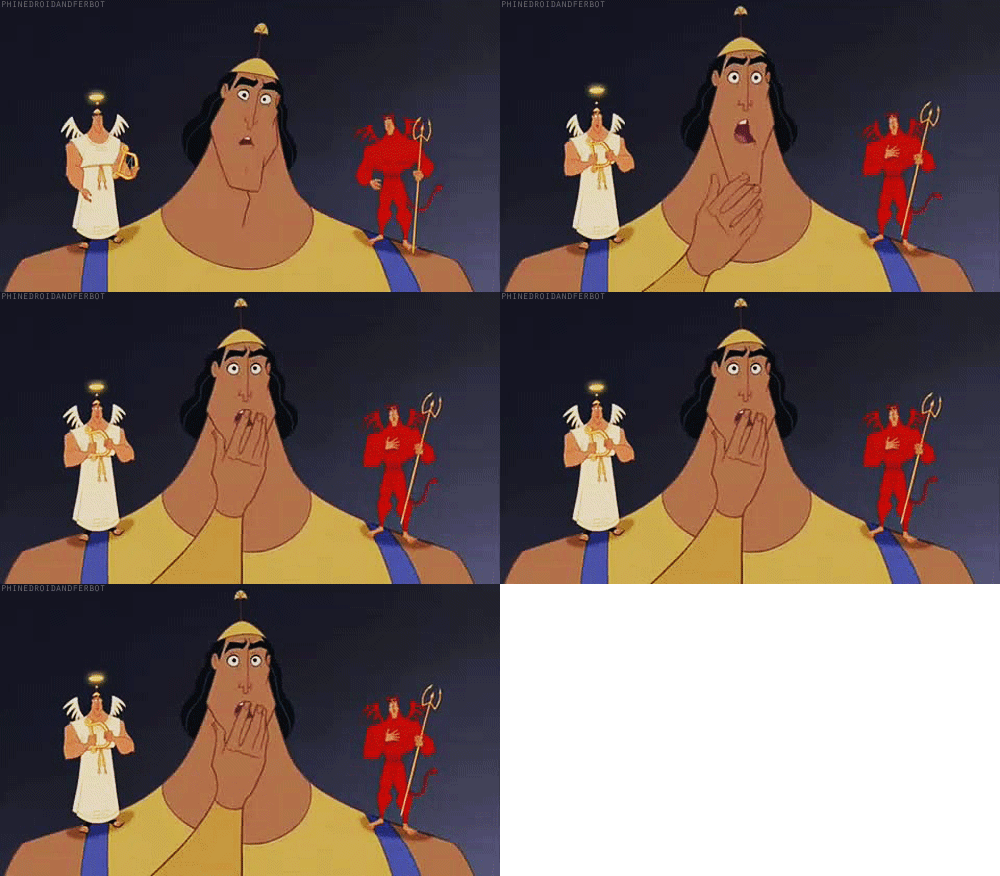
We all have an inner voice with a moral bent. It talks to us and we talk back, usually in our heads but sometimes out loud. The Bible calls this conscience. Here is an example of this conversation from a bizarre story that is stranger than fiction. It is from a Forbes article documenting how the uber rich do not escape the hardships of life.

“One of the strangest and disturbing tragedies involves a billionaire heir, Robert Durst who was arrested in 2015, after implicating himself in the suspected murders of three people in HBO’s documentary “The Jinx.” Durst, who is a member of the New York real estate family worth $4.4 billion, had long been suspected to have killed his first wife Kathleen, who went missing in 1982. After leaving an on-camera interview for the documentary, his lapel microphone was still on, and Durst said to himself: “What the hell did I do? Killed ’em all, of course.” And humiliated a family that once had the world in their palm.”

Romans 2:14-15 “For when Gentiles, who do not have the law, by nature do what the law requires, they are a law to themselves, even though they do not have the law. 15 They show that the work of the law is written on their hearts, while their conscience also bears witness, and their conflicting thoughts accuse or even excuse them…”

The Holy Bible: English Standard Version. Wheaton: Standard Bible Society, 2001. Print.

Source: Aubrey McClendon’s Sad Death And 8 Other Tragic Stories Involving The Super Rich – Forbes

Brian Regan Live

A couple of weeks ago my wife and I saw Brian Regan live in Visalia. It was a Christmas present to her with a little delay on it.  We have been fans of his comedy for many years.  It is common to hear his jokes quoted around the Troupe house.  You should definitely go see him if his tour comes near you.  Most of his older stuff is available on Youtube and Netflix. He is a clean comedian that is truly funny without being cliched, forced, or cheesy. My life is better off because of his humor 🙂

You can find tour info on his page here at Brianregan.com

His routine included an hour of completely new material. We saw Jim Gaffigan several years ago and he was good but much of his routine was recycled content. Still good, but nothing fresh on that occasion.  During the encore Regan did 20 minutes of older stuff by request. People in the crowd actually brought signs and held them up with their requests, like fans at a football game.  He did his bit on getting a hearing test at the end. It was fantastic.

Some thoughts:

  • The Fox theater in Visalia was great. Nice venue.  It felt intimate. Go early, there lots of restaurants and pubs within walking distance.  And also, there is a Hobby Lobby near by. The wife insisted we stop and browse.
  • His humor is contagious. At the end of 80 minutes I was still laughing with the little strength I had left.
  • His observations on people and politics are always genius and very quotable. He is great at the set-up and has wonderful comedic timing in his live show. Several times in the past on his recorded sessions he seemed rushed because of the TV time table. This was not a factor and made a difference.

Essentialism Chapter 8 Discussion Questions

Protect The Asset

Questions for Essentialism

Chapter 8

You can download a pdf of this here: Essentialism Questions Ch. 8

This is a list of discussion questions to help work through the content of the book “Essentialism” By Greg McKeown.

Major principles:

Protect the asset. You need to care for your mind and body through rest and sleep so that you can understand what is important and be effective over the long haul

Key examples/illustrations

  • Entrepreneur Geoff and burnout, panic attacks. Highly successful yet believing he had no limits.  His overwork required a 2 year sabbatical for healing.
  • The study quoted by Malcom Gladwell in his “10,000 hour rule” for excellence also requires adequate sleep.
  • Harvard Medicine Sleep School and the article “Sleep Deficit: The Performance Killer.” Sleep deprivation leads to impairment similar to a blood alcohol level of .1%.
  • Journal of nature study about puzzle solving abilities and the beneficial effects of sleep.
  • Google sleep pods.
  1. Getting enough rest may involve scaling back on work and other activities. Why is scaling back so hard for you?
  2. The belief that we can “do it all” can reveal a dangerous pride. We think the limits do not apply to us. Do you feel that needing rest is a sign of weakness?
  3. When so many others are burned out and exhausted, we may be reluctant to take time off because it will look like weakness or a lack of commitment. Are you afraid of looking uncommitted or weak?  Who are you worried about disappointing? Why?
  4. Without rest, we might be able to do some amazing things in the short run. But we may also have problems in the long run. Think of your important relationships and work. What would happen to those relationships and projects if you suffered a 2 year health crisis due to burnout?
  5. McKeown writes  (p.94) “By the time I was twenty-one I too thought of sleep as something to be avoided. To me, it was a necessary evil.”  Do you have a philosophy of sleep?
  6. How do you feel about sleeping in on a day off? Do you feel guilty? Do you struggle feeling like you have to justify this to yourself or others? Why?
  7. McKeown quotes Bill Clinton when he said that every major mistake he had made in his life happened as a result of sleep deprivation. Has anything like this (major or minor) happened in your life? Reflect on this.
  8. Why might sleep deprivation lead to poor decision making? What does this reveal about your mind and emotional needs for making decisions?
  9. What is the difference between operating at a high level of contribution and just being busy? How does sleep influence this?
  10. One reason that we struggle with getting sleep is the myth that if we sleep less we will accomplish more.  Why is this idea wrong headed? What is the truth that we need to shatter this lie?
  11. We readily reject the idea that people can perform well at work while drunk, yet we don’t think much about people that come to work sleep deprived.  Why is this inconsistent? What can we do about it?
  12. Pulling an “all-nighter” and working through exhaustion can give the appearance of productivity and commitment.  How is this different than real effectiveness in the long run?
  13. The author quotes the Journal of Nature Study on the improved puzzle-solving abilities of people with more sleep. This suggests something about how our brain works to solve problems.  Re-read pages 99-100 and put into your own words the benefits of sleep for solving difficult problems and creativity.
  14. Being sleep deprived affects our ability to distinguish between the vital few and the trivial many.  Apply this: What does it suggest about your sleep patterns? How can you use this to make better decisions?
  15. In the high success world some top leaders and creative people are talking more about the importance and value of sleep. Think of a person that you respect who is both highly productive person and also makes sleep a priority?  Read the WSJ article “Sleep Is the New Status Symbol For Successful Entrepreneurs” quoted in the book to delve deeper on this subject.

What Is Behind The Tattoo Impulse?

Why do people get tattoos, piercings, and other forms of body alteration?  Mark Bauerline at First Things has scratched out his eloquent, and mildly elusive opinion. I have inserted a few choice paragraphs below.

“Why? Because while the body satisfies human desire, it also impedes it. Women want to be thinner and their hips won’t comply. Men want to bulk up, but it takes too much work. Young women think their breasts are too small, and their boyfriends agree. People wish that their skin were lighter or darker, their hair had more curl or less. Men feel trapped inside a woman’s body, women in a man’s.

The body, too, is a focus of judgment, whether we like it or not. It excites or repels. It lends itself to unwanted racial and sexual stereotypes.

To overcome the problems, the academic argument goes, we must displace a longstanding conception. People have idealized the human body, treated it as a temple, a purity, and that mystification must end. The body is NOT a natural thing or divine form. It has no natural or supernatural status. That’s what my friend meant when he insisted on coloring hair, writing words on forearms, inserting studs in tongues, and otherwise modifying the physique. We must de-naturalize the body, redefine it as a human construct. A tattoo helps turn this object we seem to have been given into material we may shape and revise. Yes, each one of us is stuck with the one we’ve got (at this point in time), but we can re-create it, fashioning it into an expression of the identity we prefer.

That’s the theory of body art. It spells a transition from the body as physique to the body as text. You can write yourself upon it. As a friend put it to me: A tattoo isn’t the Word made flesh, but the flesh made word. It may strike old-fashioned types as pedestrian narcissism and adolescent conformity, and sometimes it surely is. But in a deeper and more troubling way, it is canny and subversive artifice, spiced with a moralistic claim to personal liberation. A tattoo is a personal statement but also an anthropological position that accords with the prevailing transvaluations of our time. It’s a wholly successful one, too, judging from the entertainment and sports worlds, and youth culture. With the mainstreaming of tattoos, another factor in the natural order falls away, yet one more inversion of nature and culture, natural law and human desire. That’s not an outcome the rationalizers regret. It’s precisely the point.”

Source: A Theory for Tattoos | Mark Bauerlein | First Things

Peace or No Peace? Which Is It? — Free Grace Church

Here is a post I wrote on our Church blog at Freegracefresno.com

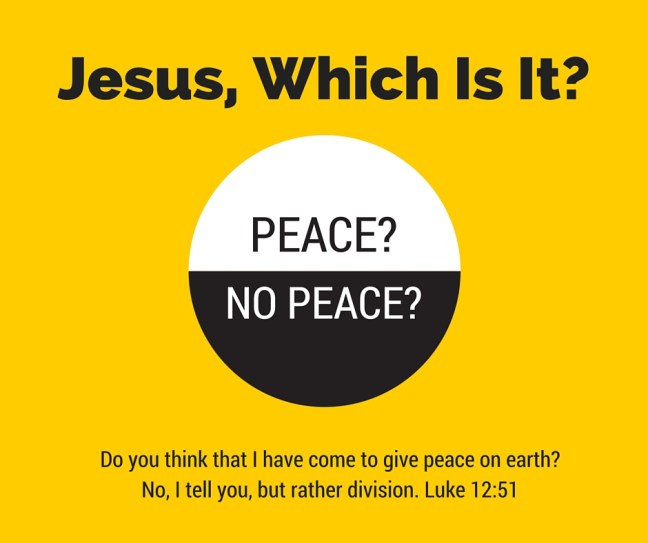
Jesus says “Do you think that I have come to give peace on earth? No, I tell you, but rather division.” (Luke 12:51).

After discussing how sin reveals itself in social structures I discuss the way that Jesus calls us to stand against the current around us. But that is still expensive. How could anyone be joyfully willing to pay that price?

“Here is the good news. Every other group that demands your allegiance will take advantage of you. They will use you for their own ends. They will expect you to sacrifice yourself for the good of the group. But Jesus is different. Just before he says that he did not come to bring peace, he says this, “I have a baptism to be baptized with, and how great is my distress until it is accomplished?” (Luke 12:50). What is this baptism? It is referring to his death on the cross (Mark 10:38).  Every other group is a kind of vampire. They will use you for their own ends.  And if you fail them, they will disown you. But Jesus, the only one worthy of your complete devotion, laid down his life for yours.  And he had to do that because of your misplaced loyalties.   And it is this love and sacrifice that is the power that moves us. It allows us to suffer the loss of relationships, respect, and approval that comes from standing with Christ against the world.”

Source: Peace or No Peace? Which Is It? — Free Grace Church

How could you lie to so many for so long?

liar

The questions that reporters ask often reveal deep cultural bias.  More often they are comical, and once in a while deeply ironic. This is from Ravi Zacharias

“Journalism is classified within our minds into certain categories. I had to smile when Tiger Woods gave his first interview after his tragic fall from grace. One of the press reporters audaciously asked him, “How could you lie to so many for so long?” That, coming from a journalist, had to be the most ironic thing I had heard for a long time. But whether we like it or not, the media news is part theater and part information.” (emphasis added)

Zacharias, Ravi K. Why Jesus?: Rediscovering His Truth in an Age of Mass Marketed Spirituality. New York, NY: FaithWords, 2012. Print.

Real Men Cry, At Least In Epic Stories and Older Generations. A Brief Literary and Cultural History of Public Male Crying.

Here is a fascinating article on an unexpected subject: Men crying in public. Sandra Newman writes about the literary and cultural history of masculine weeping. She makes a good case that our current western practice of restraint is not the norm throughout history. The Greeks, the Bible, Christian history, English literature, and even Japanese literature is full of mass, public, unrestrained, and unapologetic weeping by manly men.

Based on research men today cry far less in public than women do. And the author tries to challenge the idea that this is a result of genetic differences. She does this based on her journey through history and literature. But I am not convinced. Even if men in other cultures and eras cried more than they do now, that doesn’t necessarily mean that public crying is biologically a gender neutral affair. She has made a good case that modern men do not cry as often as the men of other cultures. But that is not the same as saying men and women are identical. In fact, if anything is a cultural anomaly it is our attempt to prove biological equality between the sexes.

She suggests that the change in our view of crying can be tied to 2 things: First, we moved from an agrictultural economy into the industrial revolution. Second, we moved from living in small villages with close relationships to big cities where we lived with strangers. In I opinion, these ideas have merit.

Also interesting is the idea that crying serves an important social purpose. When we cry, especially in public, it is good for us as a release and it is a call for help to those around us.  If this is true, then failing to cry would not be good for us.

The Bible does say, “Those who sow in tears will reap in joyful shouting.” Psalm 126:5

She writes,

“However, human beings weren’t designed to swallow their emotions, and there’s reason to believe that suppressing tears can be hazardous to your wellbeing. Research in the 1980s by Margaret Crepeau, then Professor of Nursing at Marquette University in Milwaukee, found a relationship between a person’s rate of stress-related illnesses and inadequate crying. Weeping is also, somewhat counter-intuitively, correlated with happiness. Vingerhoets, a professor of psychology at Tilburg University in the Netherlands, has found that in countries where people cry the most, they also report the highest levels of satisfaction. Finally, crying is an important tool for understanding one’s own feelings. A 2012 study of patients with Sjögren’s syndrome – whose sufferers are incapable of producing tears – found they had significantly more difficulty identifying their emotions than a control group.

“You might also suffer if you simply hide your tears from others, as men are now expected to do. As we’ve seen, crying can be social behaviour, designed to elicit care from people around you. While this might be inappropriate in the context of a performance review, it could be an essential way of alerting friends and family – and even colleagues – that you need support. Taboos against male expressiveness mean that men are far less likely than women to get help when they’re suffering from depression. This, in turn, is correlated with higher suicide rates; men are three to four times as likely to commit suicide as women. Male depression is also more likely to express itself in alcoholism and drug addiction, which have their own high death toll. Think of stoical Scandinavia, whose nations rank high for productivity – but also lead the world in rates of alcoholism and suicide.”

Source: Is there anything wrong with men who cry? – Sandra Newman – Aeon

Driven to distraction: Our wired generation – Colorado Daily

motorcycle phone distraction

Do we need any more research confirming that we are VERY distracted As a culture?  Do we need more experts warning us about the danger of being constantly wired? Do we actually need someone to tell us that being distracted hinders students from learning?

I am convinced that we need to hear more about this for several reasons. First, the situation isn’t getting any better.  Mobile devices are now universal, especially for the younger generation. But gradually older folks are jumping on board. There is no turning back.

Second, the longer we live with connected devices, social media, mobile phones, etc. the more “normal” our distracted state becomes. We become numb to the side effects, and even forget that an undistracted life is possible.

Third, this much distraction is bad for us. The longer we study this subject the more we realize that distraction is hurting our brains, our relationships, and our joie de vivre.

Here is what Larry Rosen has to say:

“Recently my research team observed 263 middle school, high school and university students studying for a mere 15 minutes in their homes. We were interested in whether students could maintain focus and, if not, what might be distracting them. Every minute we noted exactly what they were doing, whether they were studying, if they were texting or listening to music or watching television in the background, and if they had a computer screen in front of them and what websites were being visited.

“The results were startling considering that the students knew we were watching them and most likely assumed we were observing how well they were able to study. First, these students were only able to stay on task for an average of three to five minutes before losing their focus. Universally, their distractions came from technology, including: (1) having more devices available in their studying environment such as iPods, laptops and smartphones; (2) texting; and (3) accessing Facebook…

“So, what was going on with these students? We have asked thousands of students this exact question and they tell us that when alerted by a beep, a vibration, or a flashing image they feel compelled or drawn to attend to that stimulus. However, they also tell us that even without the sensory intrusions they are constantly being distracted internally by thoughts such as, “I wonder if anyone commented on my Facebook post” or “I wonder if my friend responded to the text message I sent five minutes ago” or even “I wonder what interesting new YouTube videos my friends have liked.” Three-fourths of teens and young adults check their devices every 15 minutes or less and if not allowed to do so get highly anxious. And anxiety inhibits learning.” (emphasis mine)

Source: Driven to distraction: Our wired generation – Colorado Daily