Duty to Die: Author Says Too Few People in Oregon are Requesting Assisted Suicide

being mortal

How about this for piling on.

Here are my brief thoughts about someone else’s article. That article is kind of a review of a book review.  More like a response. And I just happened to finish that book, and I really enjoyed it. The book is called, “On Being Mortal” by Atul Gawande the Harvard trained surgeon who has produced a number of good books in the last decade. I have read them all 🙂

Anyway, Gawande’s book is about aging and dying and how the healthcare system has not done a very good job in actually helping people live better lives during the last phase of their journey. He spends a few pages talking about assisted suicide, and I would disagree with what he says (he thinks it is OK under some circumstances). But regardless of your position, he makes what I think is a compelling point. In America, and other countries, we are making huge strides in palliative care and hospice services.  And contrary to popular conception, those treatment modalities are not about helping people die as much as to live as well as they can during those difficult days.  People with painful and  incurable diseases are choosing to live out their days with family and finding more dignity than they knew was possible. And it is worth mentioning that how we live when we are dying is an important part of the human journey. How the story ends is truly important.

But it seems that in the Netherlands, the availability of assisted suicide has become the quick fix that has railroaded more promising alternatives. Rather than developing health care systems that can help people live full lives to the end, they have opted instead for something more sinister in the name of “dignity.”  Here is a quote from Gawande’s book, ”

 “I fear what happens when we expand the terrain of medical practice to include actively assisting people with speeding their death. I am less worried about abuse of these powers than I am about dependence on them.”

“The implication is that we might begin to substitute assisted dying for palliative care and hospice. He points to the experience in the Netherlands, where he says the fact that “one in thirty-five Dutch people sought assisted suicide at their death is not a measure of success. It is a measure of failure.”

The author of the article at LifeNews.com, Wesley Smith J.D. makes a point that is even more disturbing. Marcia Angell, an author who is an advocate for assisted suicide, has been quoted as saying, “I am concerned that too few people are requesting it. It seems to me that more would do it. The purpose of a law is to be used not to sit there on the books.”

Is this debate about presenting options that people want, or imposing your choice on others?

Source: Duty to Die: Author Says Too Few People in Oregon are Requesting Assisted Suicide | LifeNews.com

A Happy Atheist Challenges The Angry Atheists With The Difference Between A Fact And A Value

I have read several articles by John Gray and enjoy his writing and insight.  I know when an author is connecting with something important to me because I talk out loud while I am reading it.  I mumbled pretty much the whole time I was reading this one. I had to stop and reread several paragraphs for effect, and kept interrupting my wife to read several of his more powerful points to her. Yes, I am a nerd. This essay put into words a number of things I have been thinking.

Gray is not a believer, and so he has a very different outlook than I do (as a Christian), yet his awareness of the history of philosophy allows him to see the naked spots in the emperors wardrobe. He is disenchanted by the vocal tribe of evangelistic atheists that seem to be known for their pulpit-pounding-religion-hating self righteousness. (Dawkins, Harris, etc.) And he takes them to task, not because of their unbelief but because of their inconsistencies in applying what they believe.  He is willing to explore the assumptions beneath their beliefs, and finds them to be often unreasonable.

In this essay, Gray very briefly chronicles the racist behavior of 19th and 20th century evolutionary atheists.  Then he freely acknowledges that while modern atheists disavow these beliefs, they have repeated some of the same intellectual mistakes as their forbears. They have failed to acknowledge the difference between facts and values.  And this is a dialogue-ender if you happen to disagree with them because you will be talking about your values while they dismiss you as unscientific. They believe that their values are scientific, and therefore as unassailable as discussing gravity.  And sadly, too often this leads them to view their opponents with patronizing contempt.

By the way, this was the same problem with the communism of Russian and China. Marx’s writings insisted that his view of economics was “scientific.”

I paused to read several parts of this essay more than once, not only to understand his observations, but also to enjoy them.   I disagree with his view of the world, but enjoy his intellectual honesty and clear view of the logical problems in the foundation of the new atheism.

“It has often been observed that Christianity follows changing moral fashions, all the while believing that it stands apart from the world. The same might be said, with more justice, of the prevalent version of atheism. If an earlier generation of unbelievers shared the racial prejudices of their time and elevated them to the status of scientific truths, evangelical atheists do the same with the liberal values to which western societies subscribe today – while looking with contempt upon “backward” cultures that have not abandoned religion. The racial theories promoted by atheists in the past have been consigned to the memory hole – and today’s most influential atheists would no more endorse racist biology than they would be seen following the guidance of an astrologer. But they have not renounced the conviction that human values must be based in science; now it is liberal values which receive that accolade. There are disputes, sometimes bitter, over how to define and interpret those values, but their supremacy is hardly ever questioned. For 21st century atheist missionaries, being liberal and scientific in outlook are one and the same.”

“For 21st Century atheist missionaries, being liberal and scientific in outlook are one and the same.”

Some other big ideas from this essay:

  • Atheism is not monolithic, and most of the values (and fact claims) advocated by modern skeptics are not self evident, and are not agreed on by everyone in their camp. This alone should challenge their confusion of facts and values.  I have some atheist friends that like to point out how hard it is to find Christians to agree on any matter of doctrine. Well, evidently they live in the same world.
  • Many of the new atheists are ignorant of the nature of their own beliefs. They take their own view of the world for granted and are unwilling to subject it to the same intellectual scrutiny that they demand from others.
  • New Atheists have largely ignored the writings of Nietzsche. Why? Gray writes, “The reason Nietzsche has been excluded from the mainstream of contemporary atheist thinking is that he exposed the problem atheism has with morality. It’s not that atheists can’t be moral – the subject of so many mawkish debates. The question is which morality an atheist should serve.”  Which is to say that Scientific atheism does NOT lead to a self evident view of the moral world. It cannot answer the most basic questions about how we should live without departing from its limiting scientific commitments. Further, many of the tenets of humanism advocated by atheists actually derive from Judeo-Christian religious tradition.
  • The hostility to religion that has been on display from the evangelistic atheists doesn’t make any rational sense.  After mentioning several influential atheists from the past that were NOT hostile to religion, Gray writes, “Above all, these unevangelical atheists accepted that religion is definitively human. Though not all human beings may attach great importance to them, every society contains practices that are recognisably religious. Why should religion be universal in this way? For atheist missionaries this is a decidedly awkward question. Invariably they claim to be followers of Darwin. Yet they never ask what evolutionary function this species-wide phenomenon serves. There is an irresolvable contradiction between viewing religion naturalistically – as a human adaptation to living in the world – and condemning it as a tissue of error and illusion. What if the upshot of scientific inquiry is that a need for illusion is built into in the human mind? If religions are natural for humans and give value to their lives, why spend your life trying to persuade others to give them up?”

I disagree with Gray on much of this, but his point is a good one. If atheism and evolution is true, then it follows that religion is a survival adaptation.  If that is true, why so much angst over gene expression?

Source: What scares the new atheists | John Gray | World news | The Guardian

If We Are Unaware of Human Suffering, Does It Exist? Thoughts on Chronic Pain

My sister posted this article on Facebook recently. She suffers from chronic pain and has had trouble getting a diagnosis. This article by psychologist/ neuroendocrinologist Chandler Marrs discusses pain in terms of a philosophical principle. We don’t need to be in the forest to believe that trees fall when we are not there, and that they make noise even when no one is around to hear them.  She says that we tend to think that “awareness predicates existence,” when that is clearly not true. If we close our eyes, the world doesn’t cease to exist.

The big idea in this article involves depending on our ability to “measure” pain objectively as prerequisite to its existence. Does pain only truly exist only when the clinician can objectively perceive it? Is it possible that there are some disease states for which we do not yet have adequate tools to be able to measure it? The fact that millions of people complain of pain where clinicians cannot identify the causes should make us consider the limits of our knowledge and tools. 

Why is this important? In my experience as a healthcare provider, if someone higher in the chain of command ran all the available tests and couldn’t identify a known cause for the pain, then often the conclusion was not favorable. We thought that the patient was seeking drugs, or that they had some kind of mental imbalance. The polite term may have been “somatoform disorder.”  They were often lumped into that big diagnostic basket of “fibromyalgia,” which basically meant “you have pain and we can’t find a reason for it.”  This label could easily function as a flag to dismiss the reality of the patient’s claims.

Marrs also discusses how our perception is affected by our humility and our humanity.  Our compassion is based on our ability to believe that another person is truly suffering.  A lack of empathy can result in an inability to perceive someone else’s problems.

If we put these two factors together we may find that our insensitivity prevents us from believing someone’s  complaint, and concluding that it is not real.  And since there are real “malingerers” and drug seekers out there, we can easily put people into that category when they don’t fit. The result is tragic.

She writes:

“In the case of modern medicine, if the suffering is invisible to current diagnostic tests and intractable to medical therapeutics, it is not real. Indeed, whether cognitively or reflexively, every time a physician dismisses a patient’s complaint or prescribes an anti-depressant for pain, he denies the existence and veracity of their suffering. He denies the tree in the forest, because he does not see or hear it himself in the context necessary to recognize it – e.g. by currently available diagnostic technologies and taxonomies. Here, medical technology, and the physicians who wield the technology, assume an infallibility that precludes the existence of realities beyond their sight lines, beyond their control.”

Source: If We Are Unaware of Human Suffering, Does It Exist? – Hormones Matter

‘Notes on the Death of Culture’ by Mario Vargas Llosa

Vargas

Wow… I want to read this book. Here are a few quotes from a review in the Irish Times. My first time at this website though I do have some Irish ancestry… In this book, an  aged Nobel Laureate and thoughtful critic mourns the state of our culture. He is not a Christian preacher, but according to the reviewer, his anger makes him sound like one at times. Is it possible for us to appreciate the speed of decay in our own generation?

He suggests that while we may not be living in the worst of times, we are living in the stupidest….

“It’s not easy, however, to be orderly on such an all-encompassing and sensitive subject as the way we live now. On some aspects, such as the art business, Vargas Llosa practically foams at the mouth. The art world is “rotten to the core”, a world in which artists cynically contrive “cheap stunts”. Stars like Damien Hirst are purveyors of “con-tricks”, and their “boring, farcical and bleak” productions are aided by “half-witted critics”.

“We have abandoned the former minority culture, which was truth-seeking, profound, quiet and subtle, in favour of mainstream or mass entertainment, which has to be accessible – and how brave if foolhardy of anyone these days to cast aspersions on accessibility – as well as sensation-loving and frivolous.

“Value-free, this kind of culture is essentially valueless.

“Vargas Llosa adopts a name for this age of ours coined by the French Marxist theorist Guy Debord. We live in the Society of the Spectacle. A name that recalls the bread and circuses offered to a debased populace in the declining Roman empire. Exploited by the blind forces of rampant consumerism, we are reduced to being spectators of our own lives rather than actors in them.

“Our sensibilities, indeed our very humanity, is blunted by those who traditionally saw their role as the guardians of it.

“The intellectuals, the supine media, the political class have abandoned substance and discrimination and with treacherous enthusiasm adopted the idea of the image as truth. The liberal revolution of the 1960s, especially the events of 1968 in France, and French theorists such as Michel Foucault and Jean Baudrillard come in for a lot of invective. They have turned culture into “an obscurantist game for self-regarding academics and intellectuals who have turned their backs on society”.

“Meanwhile the masses exist, docile and passive, in a world of appearances, reduced to no more than the audience in a kind of tawdry theatre where scenes shift from violence to inanity before our bored and brutalised gaze. Rock stars are given more credence than politicians, comedians are the new philosophers. Lifestyle merchants such as cooks and gardeners are revered as writers once were. It’s a sad and hopeless devolution from what we used to have and used to be.”  (emphasis mine)

Source: Book review: ‘Notes on the Death of Culture’ by Mario Vargas Llosa

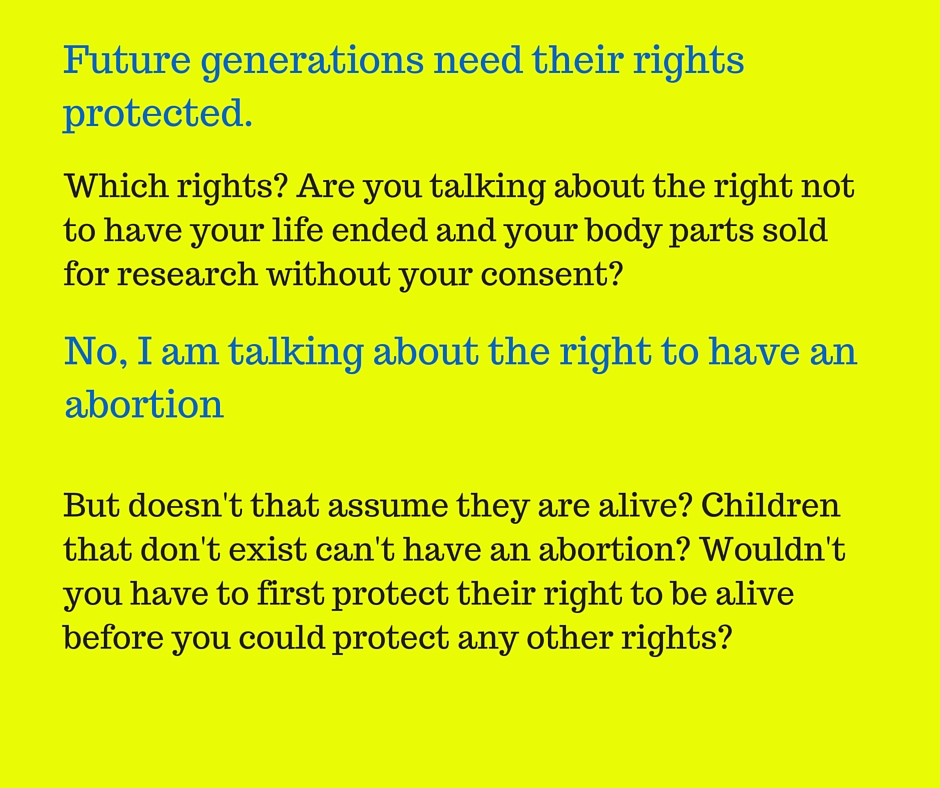
The Insanity of Using the Rights of Future Generations as An Argument For Abortion


I recently saw Planned Parenthood ReTweet this article (linked below) and I stared in disbelief.

PP insanity

Did they really just say that? That has to be someone pretending to be prochoice in order to make them look illogical…

Nope, they said it.

This is part of the insanity of abortion, that someone would try to make an argument for abortion by talking about the rights of children yet to be born.  Future generations must have the right to abort their children, even if they don’t have the right to exist. In this mindset, the right not to be pregnant trumps the right not to be killed.

But evidently we do have some responsibility to future generations? Are we responsible to them? We need to protect their rights?  On what basis? Which rights? If we don’t protect their rights, what happens?

“Will our daughters, sons and young neighbors have the same reproductive rights we have? Only if advocates of chosen childbearing tap the deep moral roots and emotions beneath abortion care.

Picture a future in which children come into the world by design rather than by default. In this future, young women and men pursue their dreams and form the families of their choosing without the ever-present risk of a surprise pregnancy that plagues young lives today. Contraceptives almost never fail, and most pregnancies are healthy thanks to “preconception care” and prenatal care.” (emphasis mine)

She also writes about an imagined pro-choice future:“In this future, young women and men pursue their dreams and form the families of their choosing without the ever-present risk of a surprise pregnancy that plagues young lives today. Contraceptives almost never fail, and most pregnancies are healthy thanks to “preconception care” and prenatal care.” (emphasis mine)

Again, note the argument. We should be able to terminate a life in order to make sure that other lives are healthy.  It sounds caring, but it is diabolical. Can you imagine if this ethic was applied to any other element of healthcare? If you’re not healthy, we’ll put you down like a dog at the vet.  (Which by the way, we should note that dogs have more rights than unborn children. You cannot inflict any pain on an animal while euthanizing it. Not so with children.)  That ethic may work for animals, but not for humans. This sounds like a soft expression of eugenics to me. Taking the life of sick people in order to improve the lives of everyone else is BAD MEDICINE.

As always, the defense of abortion is shrouded in deceptive mask of euphemisms about our dreams and prosperity. Absolute insanity

Insanity abortion

Source: Claiming Abortion Care as a Positive Social Good—Four Steps to Change the Conversation and Win

Vox: Where Philosophy Goes To Die


Crimes Against Philosophy

Trigger Warning: LOGIC

In this article (which you should read) philosophy professor Shaun Rieley takes Vox (a typically liberal publication) to task for its decision NOT publish an article by a prominent philosopher Torbjorn Tannsjo from Stockholm University.  Evidently the editors of Vox asked Tannsjo to contribute a piece for their magazine, but later decided not to publish it. What concerns Rieley, is not that Vox decided not to publish because they disagreed with the article, because they didn’t, but that they killed the piece because of the uncomfortable implications that might arrive from it.  That troublesome need for coherence…

Tannsjo argued that humans in general have a moral duty to reproduce offspring.  He arrives at this conclusion using some tight logical conclusions from utilitarian ethics.  The average person might think it is silly, but evidently his position is respected by professional philosophers and hard to evade.

All fine and good.   What is remarkable to me is that the editors at Vox don’t seem to disagree with Tannsjo, at least in general terms.  What bothers them is the idea that some conservative people might read the article and arrive at conclusions that are at odds with the editorial mission at Vox. They might use the ideas in the article to support a pro-life agenda.  It might become clear that Vox’s prochoice position is in conflict with their other values.

Rieley writes,

“In other words, it’s not so much that Tannsjo’s argument was wrong, so much as it could potentially be interpreted as giving aid to those who hold “wrong” (read: “conservative”) opinions on abortion and birth control.”

Now Vox has the right to publish whatever they like.  But what should concern everyone is that these kinds of ideological parlor tricks are happening more often.  The pattern of squashing dissent, or turning a blind eye seems to be happening more frequently in places where liberal thinkers run the show.  In my opinion, this is not intellectually honest. I have more respect anyone that acknowledges and attempts to wrestle through difficult questions  rather than toss them into the closet.

But instead we see the easy path of intellectual conformity.  We see a move to ignore or suppress facts and discussion that might disagree with the reigning wisdom.  It seems that Vox doesn’t trust people to think for themselves. They have to protect their dogma from any threats, even when those threats come from truth and reason.

Rieley continues,

“Philosophy proceeds by engaging with those various points of view, sometimes to defend what is being attacked, and sometimes to attack what is being defended. Indeed, this is how philosophy has proceeded since the time of Socrates. Without this back-and-forth, philosophy becomes all but impossible.

“Leiter laments that so few are interested in reasoning. This is true. It is much easier to retreat into the comfort of one’s own unexamined assumptions than it is to challenge them by thinking through difficult arguments that one finds disagreeable, and either assent to them, or learn to refute them.

“Nevertheless, free citizens of a republic are obligated to do the hard work of philosophical engagement. Liberty is hard work in this sense, but if liberty is to be sustained, this work is necessary. Unfortunately, by rejecting the piece, Vox has missed an opportunity to participate in the important task of facilitating this engagement.”

Source: Vox: Where Philosophy Goes To Die

Happiness is Not Found in Different Circumstances

“He who has so little knowledge of human nature as to seek happiness by changing anything but his own disposition will waste his life in fruitless efforts and multiply the grief which he purposes to remove.”

Samuel Johnson

The Evidence and The Conclusions. Anthropologist Found to Be Falsifying Evidence for 30 Years

Evidence & Conclusions

I recently saw this article about Professor Reiner Protsch. He taught at a German university for the last 30 years.  And it turns out that his status as an expert in dating various anthropological finds is not only suspect, he has been shown to be a complete fraud. Indeed many of his “facts” were manufactured.

According to Thomas Terberger, the archaeologist who discovered the hoax, “Anthropology is going to have to completely revise its picture of modern man between 40,000 and 10,000 years ago.”

Wow.

It seems that in spite of “peer review” the scientific community is really vulnerable to people manufacturing “evidence” to fill in the gaps for conclusions they have already made.  This is true even when their experts don’t even know how to run a carbon dating machine.  And it can go on for decades. The key is that the lies have to fit in with what the scientific community wants to believe. If your lies are inside the box they probably won’t be questioned. In fact it was only when a huge amount of money was at stake that someone started doing some fact checking.  Others have been challenging the “sacred cow” of peer review as being unreliable.

After I stopped laughing (because I have met more than my share of arrogant, table-pounding scientists), I realized that this is actually a sad situation for everyone.  It is horrible when the truth is handled this way.   It should lead the rest of us to  be skeptical of what we are told, even by the “experts.”  And while peer review is important, and the concept is admirable, we can’t even assume that 30 years of peer review in the “hard sciences” is fool proof.  Many well intended scientists like to speak as if their pronouncements are beyond questioning, that they are the only source of pure knowledge.  I would like to think that this will chasten the scientific community into a place of greater humility, but I am not holding my breath.

This is the conversation that came to mind when I read the article:

Skeptic: Do you believe in evolution?
Evolutionist: Not really. It is a fact. I believe in evolution the same way I believe in gravity.  Anyone that even questions evolution is clearly a blind religious zealot with no regard for the facts.
Skeptic: Why do you say it is a “fact?”
Evolutionist: Besides the obvious reality that the vast majority of scientists believe it, there is all the evidence. It is incontrovertible. Let me give you some examples….
Skeptic: So since you believe in evolution because of the evidence, if the evidence changed, or it was found to be incorrect or falsified, then obviously you would change your position that evolution is a fact.
Evolutionist: Well… not exactly. I might change what I believe about how evolution happened, but not THAT it happened.  It is undeniable that all living creatures descended from common ancestors.
Skeptic: Why do you say that it is “undeniable that all living creatures descended from common ancestors” by evolution?
Evolutionist: Because of the evidence.
Skeptic: So if you learned that the much of evidence that lead you to believe that “all living creatures descended from common ancestors” turned out to be totally incorrect, or worse an intentional lie, you would still believe it anyway? You wouldn’t be willing to rethink your conclusion? You would just rearrange some of the details? Is there any finding that would urge you to rethink your position?
Evolutionist: Why do you hate science?

Recent Philosophical and Scientific Challenges to Darwinism

Here are some highlights from a worthwhile piece at the Intercollegiate Review. The article is an excerpt from the Book, “Darwin Day In America: How Our Politics and Culture Have Been Dehumanized in the Name of Science”  The title alone is fascinating and points to something that is blind to many of my science-loving friends that don’t seem to understand the difference between science and philosophy.

Perhaps most interesting to me is the way that any dissent on the topic of evolution, even when based on scientific observations and coming from other scientists and atheists is treated as “dangerous.”

Perhaps most interesting to me is the way that any dissent on the topic of evolution, even when based on scientific observations and coming from other scientists/atheists is treated as “dangerous.”  Scientists have felt oppressed in the past, and these feelings are justified. They felt that open inquiry was not allowed.  Seems like they are returning the favor.  We look down at radical islamic countries with their anti-blasphemy laws, but we have our own blasphemy code.  If you suggest that maybe, perhaps, that possibly darwinism doesn’t exactly follow from the evidence itself… you may find angry crowds gathering around you with a heap of stones.

Now listen to John West for yourself:


“If someone prior to 2012 had predicted that Oxford University Press would publish a book with the title Mind and Cosmos: Why the Materialist Neo-Darwinian Conception of Nature Is Almost Certainly False, one might have wondered about his sanity, or at least about how familiar he was with current discourse in elite academia. But Oxford did in fact publish the book, and the intellectual aftershocks have yet to subside.

“The book’s author, philosopher Thomas Nagel, is a professor of long standing at New York University and the recipient of numerous awards and honors, including an honorary doctorate from Oxford University, fellowships from the National Science Foundation and the National Endowment for the Humanities, and election to such august bodies as the American Academy of Arts and Sciences and the American Philosophical Society. It is a testament to Professor Nagel’s stature that his dissent from Darwinian theory was allowed to be published at all. But his stature has not prevented a flood of abuse and even occasional suggestions of creeping senility….

“Nagel attracted special displeasure for praising Darwin skeptics like mathematician David Berlinski and intelligent-design proponents like biochemist Michael Behe and philosopher of science Stephen Meyer. As the New York Times explained, many of Nagel’s fellow academics view him unfavorably “not just for the specifics of his arguments but also for what they see as a dangerous sympathy for intelligent design.” Now there is a revealing comment: academics, typically blasé about everything from justifications of infanticide to the pooh-poohing of pedophilia, have concluded that it is “dangerous” to give a hearing to scholars who think nature displays evidence of intelligent design.

“Nagel ultimately offered a simple but profound objection to Darwinism: “Evolutionary naturalism provides an account of our capacities that undermines their reliability, and in doing so undermines itself.” In other words, if our mind and morals are simply the accidental products of a blind material process like natural selection acting on random genetic mistakes, what confidence can we have in them as routes to truth?

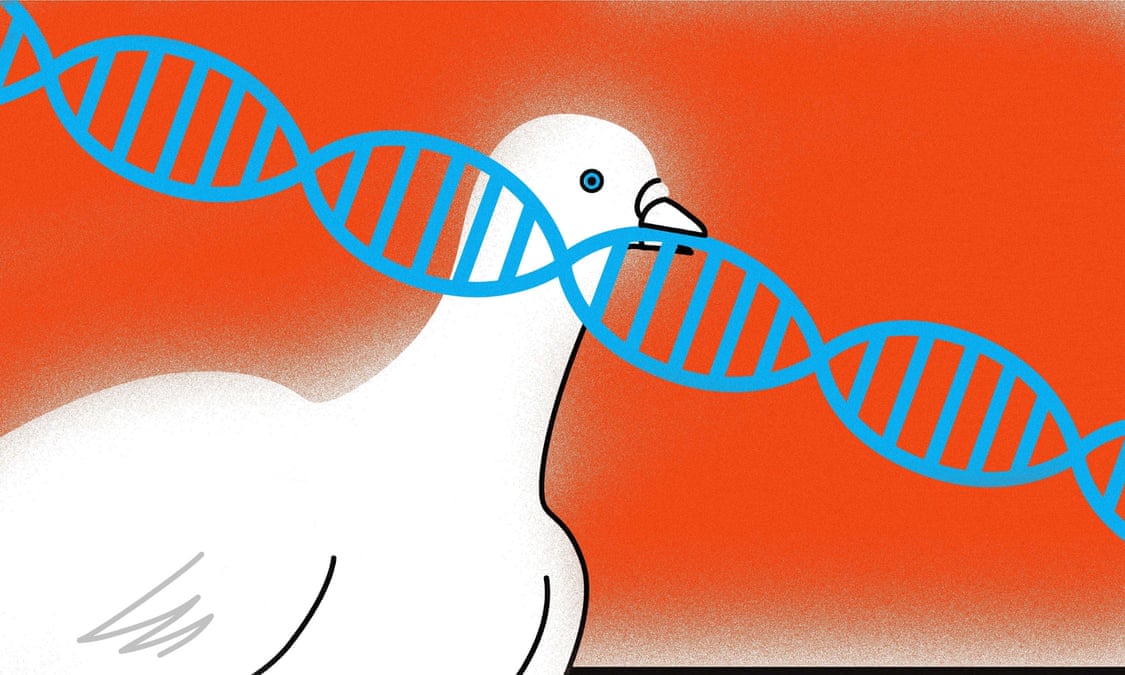
“The basic philosophical critique of Darwinian reductionism offered by Nagel had been made before, perhaps most notably by Sir Arthur Balfour, C. S. Lewis, and Alvin Plantinga. But around the same time as the publication of Nagel’s book came new scientific discoveries that undermined Darwinian materialism as well. In the fall of 2012, the Encyclopedia of DNA Elements (ENCODE) project released results showing that much of so-called junk DNA actually performs biological functions. The ENCODE results overturned long-repeated claims by leading Darwinian biologists that most of the human genome is genetic garbage produced by a blind evolutionary process. At the same time, the results confirmed predictions made during the previous decade by scholars who think nature displays evidence of intelligent design.

“Even critics of Darwin’s Doubt found themselves at a loss to come up with a convincing answer to Meyer’s query about biological information. University of California at Berkeley biologist Charles Marshall, one of the world’s leading paleontologists, attempted to answer Meyer in the pages of the journal Science and in an extended debate on British radio. But as Meyer and others pointed out, Marshall tried to explain the needed information by simply presupposing the prior existence of even more unaccounted-for genetic information. “That is not solving the problem,” said Meyer. “That’s just begging the question.”

“C. S. Lewis perceptively observed in his final book that “nature gives most of her evidence in answer to the questions we ask her.” Lewis’s point was that old paradigms often persist because they blind us from asking certain questions. They begin to disintegrate once we start asking the right questions. Scientific materialism continues to surge, but perhaps the right questions are finally beginning to be asked.

“It remains to be seen whether as a society we will be content to let those questions be begged or whether we will embrace the injunction of Socrates to “follow the argument . . . wherever it may lead.” The answer to that question may determine our culture’s future.”

via The Book That Deflated Darwin Day | Intercollegiate Review.

Insights On Human Nature From a Book Review on Maturity and Moral Reasoning.

Dr_Jekyll_and_Mr_Hyde_poster_edit2

Vivian Gornick wrote a review of the book “Why Grow Up: Subversive Thoughts for an Infantile Age,” and hiding in there I found a few great observations, and several golden sentences that beautifully express the great contradiction of human nature: that we are both full of virtue and potential, yet also perennially evil and powerless to do what we know is right. For Christians this is understood in the tension between the image of God and common grace on the one hand set against original sin on the other.

“The desire to submit to the constraints of established authority at the very same time that we long to break loose of them seems to me a fair account of one of the major miseries of the human condition.”

She also talks about the human tendency toward revolution and says that throughout history, “the cycle of submission and rebellion repeats itself, without much permanent progress having been made.” Consistently today’s revolutionary liberator becomes tomorrow’s oppressive tyrant.

Gornick also says, “The catch is that learning to think for oneself is not a given; it is an ideal, one achieved only with immense effort. We resist making the effort as it involves damned hard work.”

“The Hebrew philosopher Hillel urged that we do unto others as we would have others do unto us. Kant urged, similarly, that we not make instrumental use of one another. With all the good will in the world—and remarkable numbers of people have it—we have not been able to make these noble recommendations carry the day. Not because we are lazy or venal or incompetent but because most of us live in a state of inner conflict that makes purity of behavior an impossibility. Every day of our lives we transgress against our own longing to act well: our tempers are ungovernable, our humiliations unforgettable, our fantasies ever present. We cannot stop ourselves from scorning, dismissing, challenging, and discounting. We spend years on the couch struggling to make our reasoning intelligence subdue our impassioned outbursts. When given a recipe for the good life, we want these realities on the ground incorporated in the mix.

“Aside from that of our own permanently conflicted selves, another unchanging reality is that the world as it is has been decried since time immemorial. Throughout history women and men have been writing—letters, diaries, poems, and novels—claiming theirs the worst time ever. While many have been truly horrendous, not one is without some redeeming feature.”

via Your Own Worst Enemy | Boston Review.