Thoughts From The Other Side Of The Obergefell Decision

Thoughts From The Other Side Of The Obergefell Decision.

Some helpful thoughts in this essay by Hunter Baker from the Federalist.

Lots of people are agitated about the supreme court decision, and I understand why.  But I have also been scratching my head, because we really just traveled another mile down the road we were already traveling. This doesn’t seem like new “news” at all. It just makes official what has been happening unofficially for a long time.  Hunter Baker gives a good explanation of why this hurts for so many Christians:

“So, why the distress now? Why does Obergefell fall so heavily? It’s a little bit like being a child whose parents’ marriage is slowly disintegrating. But for years they held on. The kid knows a divorce is probably going to happen. The things that tied the family together have slowly been broken or dissolved in a long and painful process. But right up until the moment when it really happens, the child has hope. The parents criticized each other, refused to give credit, were eager to assign blame. And now it feels like it’s over. It’s not just over. Some people are throwing parties to celebrate. They’ve been hoping for this divorce for years and are thrilled to see it happen.”

He also tells a compelling story of his own journey to “real” faith in Christ (vs. the shallow cultural variety that was so common during his upbringing in the South) and how that same journey informs him now.

“Many are aglow in the wake of Obergefell. They didn’t like that old marriage between Christianity and the U.S.A. In fact, they thought America needed a new mate altogether. Call it scientific humanism or therapeutic deism, whatever. To them, this looks like the most hopeful moment yet.

“It’s hard to be the person at the party who isn’t celebrating. But I have no choice other than to be hopeful lest I discount my own conversion and spiritual quest. I believe Jesus is real and that he is the son of God. I know that men and women still seek him. Many will come as I did. He will change their lives forever as he changed mine. I know that the church and many Christians in times and places across history and around the globe have faced far greater challenges. No social change, no worldly court, no legislation will re-orient me.”

 

Birthday Haiku

Birthday Haiku

It was my birthday yesterday.  The effect of having so many dozens of friends say happy birthday is wonderful. And so many of these friends are from long ago, and from all over the place… wow. Thanks

So, here is your free gift, a Haiku:

Another birthday.
Facebook sends greetings my way
From friends far and near.

Gossiping About Ourselves

Face palm

Earlier today my wife and I were speaking about social media. It can be marvelous and miserable. We both dabble in Facebook, Twitter, Instagram, etc to varying degrees. But it is REALLY easy to be carried by the stream of pop culture and join in without thinking. So, we talk about social media. We talk about how it can be both amazing and horrible. We try to learn from our own failures (which are many) and even from the missteps of others.  Sometimes when you see several people (or whole crowds) making the same mistake all at once, it appears as a pattern.  A kind of constellation of immaturity and bad behavior.

It is almost as if the kinds of stupid decisions that people wanted to keep private in the past, have now become a staple on social media.

The constellation we talked about this morning is the tendency of some people to parade their bad decisions on social media.  Sometimes it feels like I am watching someone get another “together forever” tattoo with the name of their new lover, written just beneath the one they ditched last month.  It is almost as if the kinds of stupid decisions that people wanted to keep private in the past, have now become a staple on social media.  The grand spectacle of folly that was once reserved for gossip rags and the Larry Springer show is now available to all of us. And not just as spectators, we can be on stage, or on the cover.  But there is no one to sue for libel, because we wrote it. And, oh yeah,  it’s true..

Many of the things I am now able to learn (forced to endure?) about my Facebook friends would have only been available to me in the past if someone had been trying to destroy their reputation through gossip.  I would really like to mind my own business, but you won’t let me! It’s not that I want people to lie, I just feel really uncomfortable when people gossip about themselves.

I would really like to mind my own business, but you won’t let me!

And sadly much of this adolescent flaunting is presented with a measure of boldness. “This is who I am, IF YOU DON’T LIKE MY BAD DECISIONS, YOU ARE THE ONE WITH THE PROBLEM.”   And I do end up with a problem, Facebook only has a “like” button.  I could speak up and be perceived as judgmental (a risk I am willing to take because I love my friends), or stay quiet while you document your own personal episode of Jackass for the world to see.

Regret is a powerful experience, tasted by all at some point. And one of the things that makes regret more damaging is publicity. It is one thing to trip and fall. It is another thing to trip and fall on camera and then to see our private moment of shame become a viral experience. It is one thing to be laughed at by a few friends and strangers, it is much harder to endure the scorn of millions.  And sadly, this level of regret is more potent when there is a permanent record. What will it be like when the posts you wrote last year, the ones that already embarrass you, can be resurrected to go viral again in 2035. And you think political campaigns are nasty now? It has been said that taking information off the internet is like taking pee out of a pool. Impossible.

So here is my advise:

1. Don’t give into the temptation to make a permanent, public record of every mistake and bad decision that you make.  One day you will want people to “forgive and forget.” Don’t make this any harder than it already is.

2. If something might really embarrass you if it ended up on film, then don’t just think twice about posting it on social media, think twice about doing it.  Some embarrassing things are perfectly innocent, and we need to learn to laugh at ourselves. Other embarrassing things can hurt us and other people.  And the only thing worse than driving toward a cliff, is driving toward it confidently with your foot on the acclerator.

3. Don’t be upset when friends and people that love you (especially older ones) have the courage to tell you that you are making bad choices.   There is a strong possibility you will soon agree with them. And you may need their help to clean up the mess.

Photo used courtesy of Hobvias Sudoneighm. Some rights reserved.

Essentialism Ch. 4 Discussion Questions

Essentialism

This is a list of discussion questions to help work through the content of the book “Essentialism” By Greg McKeown.

Download a pdf of the questions that is more friendly for journaling here: Essentialism Questions Ch. 4

Major principles:

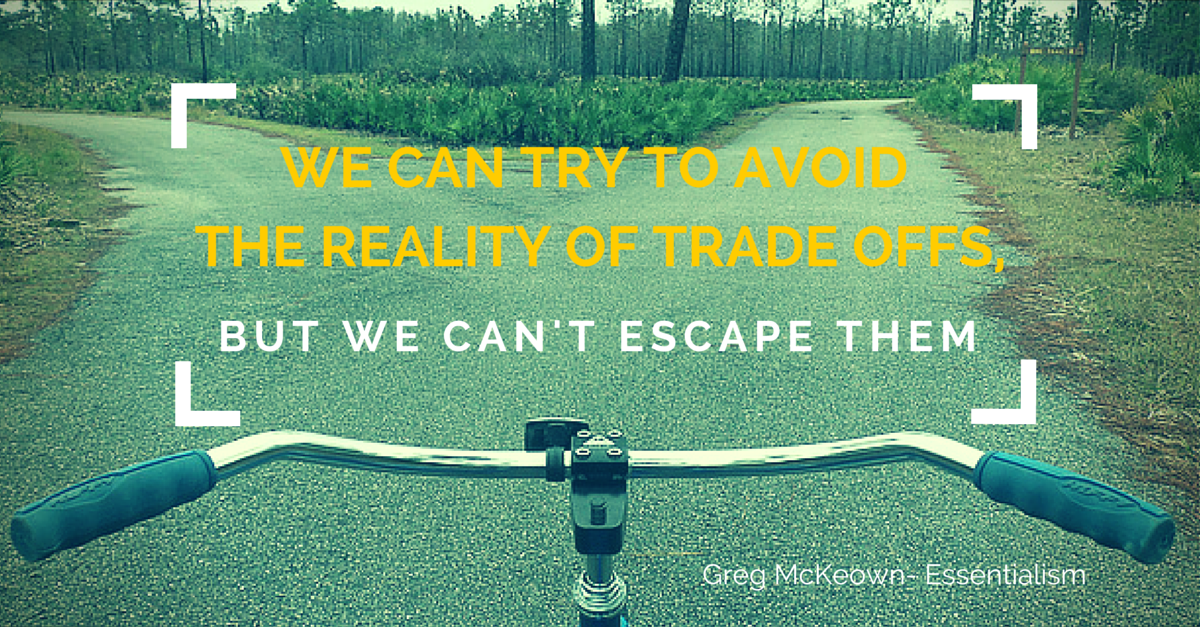
  • Every decision is a trade off. Since we can’t have it all, choosing one thing is not choosing another.
  • What trade off do I want to make? How can I do this deliberately rather than by default?
  • What can I go big on? Rather than “how can I do it all?” or “What do I have to give up?”
  • You need time and space to adequately consider the tradeoffs before you.

Key examples/illustrations

  • Southwest airlines deliberately rejecting certain options so they could focus on their core business.
  • Businesses that choose a straddling strategy. Trying to imitate a competitor while keeping their old strategy doesn’t work.
  • Johnson and Johnson’s response to the Tylenol cyanide crisis.
  • Businesses with lengthy mission statements or lists of values.
  1. The chapter opens by talking about the financial success of Southwest Airlines which is an example of a business with an essentialist strategy. Southwest said “no” to many things so they could focus on their strategy.  What does this suggest about the promise of essentialism?
  2. A person that is chronically late and stressed is often trying to fit in “just one more” email or action item. This has a domino effect on other important things. What insignificant things are you attempting in the name of “efficiency” that are undermining your focus?
  3. Are there tasks/responsibilities that are a part of your routine just because they seem easy for you to accomplish?  Are there things that you are doing that are not a priority, but that you don’t quit because they are not difficult?
  4. We often multitask when we fail to recognize the reality of trade offs. What happens when you multitask? What trade offs are you making?  What are you giving up? What are you gaining?
  5. There is a difference between making trade offs deliberately vs. by default. Think of a significant disappointment in your life/business. Was there a tradeoff in your choices?  Was it one that you made intentionally or that you allowed others to make?
  6. McKeown suggests that lengthy mission statements and lists of values show the failure to grapple with the reality of trade offs.  Have you seen this? Do you agree or disagree?
  7. The nonessentialist says “I can do it all,” the essentialist says, “which problem do I want?”  What problems are you facing because of your attempts to do too much?
  8. Think of a choice that is in front of you right now.  Consider the options and ask “which problem do I want?” This will require you to think of the potential outcomes of saying yes to various possibilities. Reflect on this.
  9. McKeown says, “instead of asking ‘what do I have to give up?’ ask ‘what do I want to go big on?’”  Think of an upcoming personal decision and use these two questions to analyze it. Make a list. How does each approach affect your feelings about the decision?
  10. We often feel guilt because of FOMO, “fear of missing out.” How can being deliberate about your choices help with these feelings of fear or guilt?
  11. In order to make tradeoffs wisely we have to take lots of time for exploration and reflection before we commit.  Consider a recent life decision. Did you have time to truly explore the various options before choosing? Why? Why not?
  12. Mckeown says, “To discern what is truly essential we need space to think, time to look and listen, permission to play, wisdom to sleep, and the discipline to apply highly selective criteria to the choices we make.”  What grabs you the most about this statement?
  13. Why do we need this “space” in order to make decisions based on “highly selective criteria?”

Photo courtesy of Daniel Oines. Some rights reserved

Slow Motion Dandelion

I am not an early adopter of technology. I am also not too late to arrive at the party compared to many.  I don’t mind letting the early birds work out the bugs for me.

But this is fun. The slow motion feature has been fun on the iPhone 6. This is the first time I have used the mobile version of the iMovie on my phone. It is hard to believe that I can not only make a video with my phone but also due minor editing and produce something of quality to share. In fact, this post from beginning to end has all been done with my phone. Amazing.


Monday Morning Haiku- Mountain Cabin

Trees

Warmth

Cool mountain morning,

Threaded sunlight through branches

lifts the morning chill

-mtroupe 2015

Obviously, the poem below is not a haiku. Enjoy it anyway…
Time

The cabin rests beneath the trees

As passing seasons roll

The living wood is fresh and green

The cabin wood grows old.

-mtroupe 2015

Monday Morning Haiku- Friendship

Conversation Haiku

I wrote these after our son unexpected stopped by our home.  He attends a nearby university and we hadn’t seen him in a little while (about a week, I know that is not long, but it still feels long when you enjoy your children). Our conversation volleyed back and forth like a good tennis match. These poems are as much about conversation as friendship. Is there really much of a difference?

Haiku 3.23.15

Together Again

Conversation flows

Between friends after a break

Catching up on life.

-mtroupe 2015


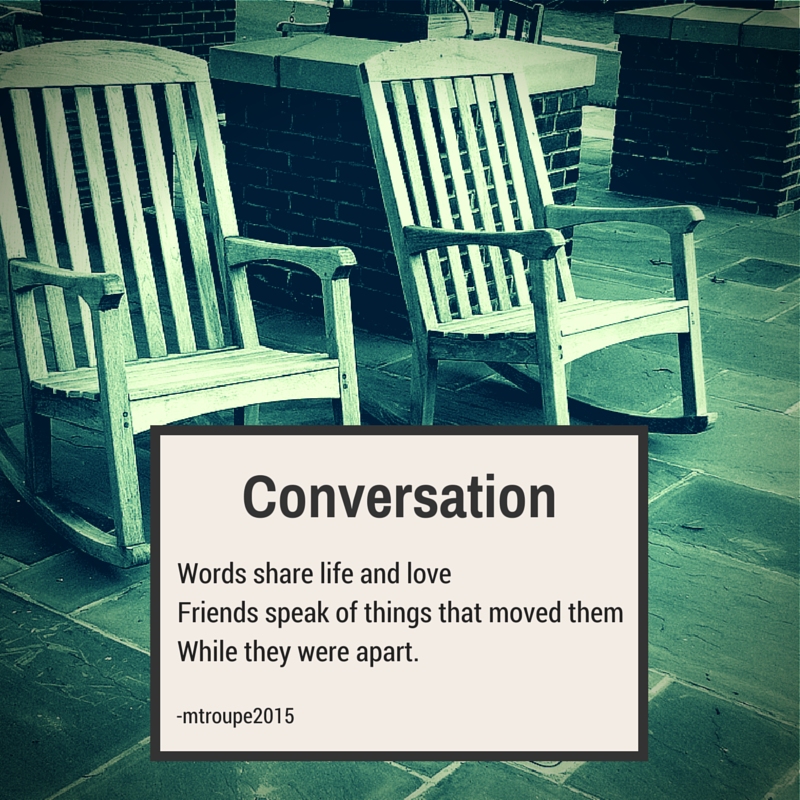
Conversation

Words share life and love

Friends speak of things that moved them

While they were apart.

-mtroupe 2015


Soul Food

Stories delight us

Nourishing the souls of friends

Bringing joy to life.

-mtroupe 2015

Edited photo used by permission of Kathleen Conklin. Some rights reserved

Monday Morning Haiku- Power Outage

Candle graphic

Haiku 3.16.15

The power was out at our house for 3-4 hours last night, starting at dusk.  Even our cell internet connection was affected. We sat and read together and it was enjoyable. But it was a reminder of how completely dependent we are on technology, and how that even impacts our relationships.

What Now?

A power outage

Darkness. No lights. No Wi-Fi

Candles lit the room

-mtroupe 2015

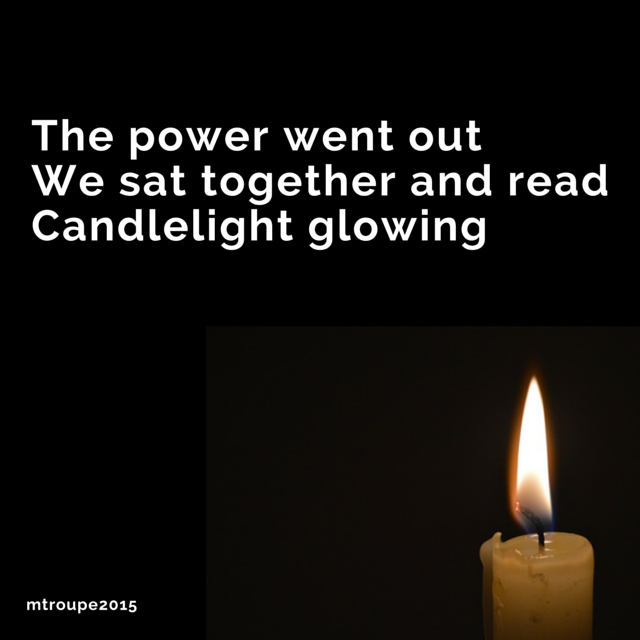
Together

The power went out

We sat together and read

Candlelight glowing

-mtroupe 2015

Memory

Ancient people lived

Without electricity

But we forgot how

-mtroupe 2015

Design

Without light, dusk brings

An end to the work of Day

Now rest, talk, and sleep

-mtroupe 2015

God Loves Me & So Does My Dog, But It’s Different

God Loves Me,And So Does My Dog. But 2

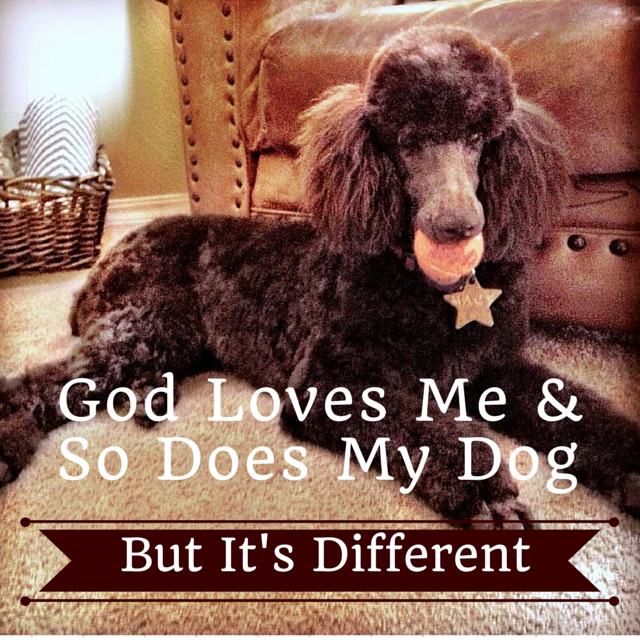
I have a 1-year old chocolate colored poodle. She’s a great dog and she’s always happy to see me. Wait, that’s an understatement. She goes nuts when we come home.  She is so excited that often she wets herself.  We feed her, and pet her.  We take her for walks occasionally. We play with her and hang out together. And that’s enough, she thinks we are wonderful.  She jumps on the bed in the morning and licks my face to wake me up. She always wants to play. And even when we aren’t playing she just wants to be near me. She follows us around the house and lays at my feet.  And all her enthusiasm and love is great for my self-esteem.  And she does this even when we ignore her. Sometimes we have to lock her up in a crate for most of the day to keep her from destroying the house. But when we come home and let her out, it’s a celebration.

For some Christians, this is a close description of how they understand God’s love.  He is really excited about us, makes hardly any demands, and won’t mind if we lock him away in a crate when we have better things to do. They have attempted to tame God, and as a result his love is… Well… Just okay.  But it doesn’t match the love we see at Calvary where we see Christ pouring out his life for an unfaithful spouse.   The puppy-dog  kind of love doesn’t produce the (seemingly) irrational joy, worship, and sacrifice we see described in scripture.  It doesn’t buoy up the soul in the face of great sin and suffering.

I am slowly working my way through “Yawning At Tigers” by Drew Dyck. He writes about this phenomenon, and our tendency to domesticate God.  Writing about modern preachers, he says:

“Unfortunately, in our efforts to make the Bible interesting and relevant, we try to normalize God. We become experts at taking something lofty, so unfathomable and incomprehensible, and dragging it down to the lowest shelf. We fail to account for the fact that God is neither completely knowable nor remotely manageable”

Unfortunately, in our efforts to make the Bible interesting and relevant, we try to normalize God.

He says that we are often uncomfortable with the mysterious, and transcendent descriptions of God. They are too strange or even unpleasant to our American sensibilities, so we explain them away.  Again, he writes “Here’s the beautiful irony: making God strange actually enables us to know him more. Once we have marveled at his magnitude and mystery, we are able to achieve the deep intimacy that grows out of a true appreciation for who God is. Instead of treating him as an equal, we approach him with reverent awe. Only when we’ve been awestruck by his majesty can we be overwhelmed by his love.”

I love my dog, and enjoy the way she worships me. And that would be the best word to describe it!  But God’s love is different, it’s not about his infatuation with my greatness.  One of the reasons we are “yawning at tigers” is because we are not impressed with the love of God. And we are underwhelmed with his love because we don’t understand his holiness, majesty, and greatness. If we did, we would understand our own sin as well and see just how much it cost him to love us.  And that would make his love something to live for.

Book Review- First Seals by Patrick O’Donnell


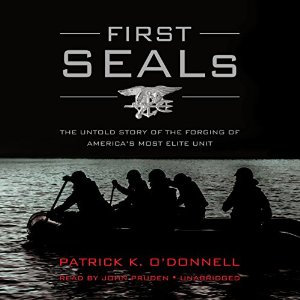
Seals book

The First Seals by Patrick K O’Donnell

I have read a number of books about special operations history, it is a kind of a hobby.  Some of these were personal memoirs and others books about unit histories.  The First Seals certainly ranks as one of my favorites.  It tells a believable story that is still amazing. And it does it without too much machismo or chest pounding.  It gives a broad history, but also focuses enough on specific individuals that you can understand the characters.  After reading this one, I want to dig into the rest of O’Donnell’s works.

If you like books about military history, read this book. 

If you like books about World War II, you will love the the back story. There are aspects of the war told in this book that I haven’t read anywhere else. Who knew that the Italians were the best in underwater demolition?

If you like books about sabotage, espionage, and partisan warfare, read this book.

If you like books about entrepreneurship, and people creating new things… If you like the books about people solving problems and taking risks, read this book.  Not all creative people work in business.

If you’re one of those people who likes fiction, but thinks that truth is often better than fiction,  you will enjoy this book.

Toward the end of the book when Lt. Taylor (one of the central figures in the story) is rescued from the Mauthausen concentration camp, I teared up. If I hand’t been driving, I would have cried. It is a great story not only of the units and tactics that would become the US Navy Seals, but a great example of American Heroism in the fight against fascism. What is amazing is that so many of the other prisoners sacrificed their lives to keep O’Donnell alive because they knew that the world would be more likely to believe an American officer.  Taylor would later serve a key role in the investigation and prosecution of Nazi war criminals.

I sound like a fan… I know.  But this was a truly great read. I consumed it on Audible.com and the reader was terrific as well. You can find it here 

You can watch original footage of Jack Taylor’s interview the the US forces liberated the Mauthausen Concentration Camp. He begins talking at 50 seconds into the video.

I first heard of the book in an article by O’Donnell in National Review that you can read here.  “Christmas with America’s First Seal in A Gestapo Prison.”