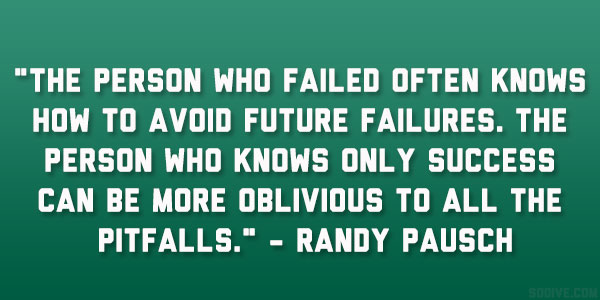
Here is a great (and brief) article on the importance of failure in developing character, growing businesses, and helping people have a good life. It turns out that trying to spare people (ourselves, our children, our employees, etc) from experiencing the pain of failure is bad in the long run. Why? We can’t gain deep wisdom without the process of learning from our failures. This is a list from the article at Forbes.com of ways to help people fail in a way that is positive for them and the organization.
“Here are some ways to increase employees’ comfort with the risk of failure, and to be resilient when it happens:
Share past stories of struggle. Everyone’s been there.
Practice recovery so people aren’t paralyzed by failure. When I was coaching sports, we didn’t just diagram plays. We always developed a Plan B. That’s why great organizations scenario-plan. It helps people think of struggle as part of the process.
Help people around you think like long-term investors in their own ideas and their own careers. The aim shouldn’t be to try to have one uninterrupted string of successes, but rather to have a portfolio of some winners and, yes, some losers.
If someone is struggling, your job is to figure out how to get them on the right path. The real job of a manager is to help people learn from failure and move forward.
Champion failure that turns to innovation. Find examples where ordinary failure has led to extraordinary opportunity.
Encourage failing fast. Sometimes we recognize that something is failing, and our instinct tells us to push harder to make it succeed. Knowing when to pull the plug is always difficult but is necessary.”
Madison Holleran posted a photo of Rittenhouse Square in Philadelphia to Instagram (right) an hour before jumping to her death.One of the deepest diseases of human nature is lying. And I am talking about something far more subtle and destructive than bearing false witness to a teacher or police officer in order to get out of trouble. One of the darkest elements of broken humanity is to lie about who we are. To create a false identity and then try to maintain it. The need to hide our pain and sin behind a mask of smiles and virtue.
The word hypocrite comes from the Greek word for a person that wears a mask. It originates with the Greek theater, where actors wore masks to disguise not only their identity but even the sound of their voices. A hypocrite is a kind of actor that pretends to be someone they are not. Traditionally this concept has been reserved for people pretending to be moral, for example religious people, public leaders, or politicians. But the concept is broader than preaching abstinence while practicing indulgence. It includes those of us who stay in character once we have left the stage. The hypocrite is essentially an imposter. We are disgusted to find out that people we respect because of their public persona are actually using their image to cover up a life of corruption and debauchery.
Well, it appears that what was once reserved for politicians and the religious is now a growing temptation for the masses. Perhaps it was there all along. But social media has provided a window into the ubiquity of human deceit. This article in the New York Post discusses growing darkness that lies beneath the surface in social media. The author cites some extreme examples, but anyone with a Facebook account understands this. We are subject to two related temptations: To lie about our own life while believing and comparing ourselves to the lies that our friends are telling. This is no joke.
Maureen Callahan, the author of the article in the NY Post cites an example of Zilla van den Born. “Last year, she uploaded a monthlong series of photos taken on her travels in Southeast Asia — scuba diving, praying in a Buddhist temple, sampling local cuisine — then revealed those images were all the work of Photoshop. She had hidden in her apartment the entire time, duping even friends and family.”
Wow, how bad does life have to be to want to do this? For those of us old enough to remember the ancient world of 10 years ago, all of this is pretty frightening.
Technology is the great magnifier. It has the potential to draw out and magnify the dark side of human nature. And can do this by several magnitudes, all while maintaining the filtered image of a smile.
Here are a few important parts of the article. The whole thing is worth reading and very important.:
‘Mai-Ly Nguyen Steers, a post-doctoral fellow at the University of Houston, has spearheaded a similar study [concerning social media].“The idea came to me when my little sister, who was 16, wasn’t invited to a school dance,” Steers, 38, tells The Post. “She told me about logging on to Facebook the very next day and seeing all these pictures of her friends at the dance, and that actually made her feel worse than not being invited.”
“Seeing Everyone Else’s Highlight Reels: How Facebook Usage is Linked to Depressive Symptoms” was co-authored with two other social psychologists and published in the Journal of Clinical Psychology last year. Steers cited the work of social psychologist Leon Festinger, who, in 1954, came up with “social comparison theory,” the idea that we measure ourselves in relation to others’ failures and successes.’
Again Callahan writes,
‘Then there are those who aggressively seek out admiration and envy. Google “GoPro proposal” and you’ll get 428,000 hits — people who planned and recorded the moment they got engaged, then uploaded it for global consumption. Some couples live-stream it. Others stage-manage the “set,” then hire professional photographers to capture the moment.
“The engagement thing is so creepy,” says Chelsea Fagan, 26, whose website, The Financial Diet, covers the impact of social media on young women. “There’s this weird arms race now where everything has to be a moment, no matter how private. We always get a lot of responses with weddings and engagements — women spend a lot of money to look ‘Pinterest perfect.’ ”
It’s not just weddings or special events, though. Social-media users spend exorbitant amounts to look like their daily, everyday lives are spent eating the finest food, wearing the most on-trend designs, living a stylish, well-appointed life — no problems.’ (emphasis added)
Salon recently published an article titled, “I’m a pedophile, but not a monster” by Todd Nickerson. The article is disturbing to me on various levels. It suggests that we are defined by our desires, indeed that we need to surrender and accept an identity formed by our appetites. It ignores the reality that some desires are evil, even if they are built-in. Further, it also avoids discussion of whether our desires can be changed. And it pretends that it is possible (and healthy- the word they used is “virtuous”) to avoid having sexual contact with children yet maintain an active fantasy life regarding them. But, considering that we have busted the dam of almost all sexual restraint in the last 40 years, I am not surprised to read it.
Breitbart ran an article challenging Salon, and suggesting that its soft stance on pedohiles is part of a larger, and growing problem from the political left. I have to wonder, Is this really a trend? Or is this an example of a few loons in a larger group. I am not sure, because I have a number of liberal friends that I know would oppose this. But reading the Salon article and not hearing a torrent of outrage from the left does make me wonder. Here is one article, (that comes from a left leaning author) that not only expresses concern over the article, but suggests that the folks on the left have a double standard on this issue. They are merciless when prominent conservatives are revealed as pedophiles, but supportive or silent when the same thing happens with their own team.
Milo Yiannopoulos writes in Breitbart:
“Pedophilia itself is of course not confined to one side of the political spectrum. But defending it does seem to be. Pro-pedophile activism continues to surface on the Left in a way that it simply doesn’t on the Right. Salonis one of the worst offenders: the left-wing website runs sympathetic features on pedophilia with alarming regularity…” (emphasis added)
And again,
“Horrifyingly, there are signs of a new pedophile acceptance movement forming on the Left. Just as Allen West warned, the gay rights movement is being used as a template. First comes the argument that pedophiles are just “born that way,” absolving them of any moral responsibility for their desires. Then comes the argument that pedophiles are just normal people, like the rest of us, but somehow impoverished or victimised by their own condition.
“Inevitably, our society’s current ostracisation of pedophiles will be portrayed as an injustice: an oppression from which pedophiles must be liberated, or for which they deserve our sympathy. And woe to the oppressors! Quietly, in progressive columns and academies around the world, progressives are losing their footing and sliding down that slippery slope. Publications like Salon are abetting the turpitude.” (see the original article for important links)
Is this assessment true? I am not sure, but the reporting does connect the dots on several hunches for me. Without a doubt this is the trajectory of a society that insists that morality is culturally relative, and views any rules limiting sexual expression as the source of our problems.
Wow… I want to read this book. Here are a few quotes from a review in the Irish Times. My first time at this website though I do have some Irish ancestry… In this book, an aged Nobel Laureate and thoughtful critic mourns the state of our culture. He is not a Christian preacher, but according to the reviewer, his anger makes him sound like one at times. Is it possible for us to appreciate the speed of decay in our own generation?
He suggests that while we may not be living in the worst of times, we are living in the stupidest….
“It’s not easy, however, to be orderly on such an all-encompassing and sensitive subject as the way we live now. On some aspects, such as the art business, Vargas Llosa practically foams at the mouth. The art world is “rotten to the core”, a world in which artists cynically contrive “cheap stunts”. Stars like Damien Hirst are purveyors of “con-tricks”, and their “boring, farcical and bleak” productions are aided by “half-witted critics”.
“We have abandoned the former minority culture, which was truth-seeking, profound, quiet and subtle, in favour of mainstream or mass entertainment, which has to be accessible – and how brave if foolhardy of anyone these days to cast aspersions on accessibility – as well as sensation-loving and frivolous.
“Value-free, this kind of culture is essentially valueless.
“Vargas Llosa adopts a name for this age of ours coined by the French Marxist theorist Guy Debord. We live in the Society of the Spectacle. A name that recalls the bread and circuses offered to a debased populace in the declining Roman empire. Exploited by the blind forces of rampant consumerism, we are reduced to being spectators of our own lives rather than actors in them.
“Our sensibilities, indeed our very humanity, is blunted by those who traditionally saw their role as the guardians of it.
“The intellectuals, the supine media, the political class have abandoned substance and discrimination and with treacherous enthusiasm adopted the idea of the image as truth. The liberal revolution of the 1960s, especially the events of 1968 in France, and French theorists such as Michel Foucault and Jean Baudrillard come in for a lot of invective. They have turned culture into “an obscurantist game for self-regarding academics and intellectuals who have turned their backs on society”.
“Meanwhile the masses exist, docile and passive, in a world of appearances, reduced to no more than the audience in a kind of tawdry theatre where scenes shift from violence to inanity before our bored and brutalised gaze. Rock stars are given more credence than politicians, comedians are the new philosophers. Lifestyle merchants such as cooks and gardeners are revered as writers once were. It’s a sad and hopeless devolution from what we used to have and used to be.” (emphasis mine)
Earlier today my wife and I were speaking about social media. It can be marvelous and miserable. We both dabble in Facebook, Twitter, Instagram, etc to varying degrees. But it is REALLY easy to be carried by the stream of pop culture and join in without thinking. So, we talk about social media. We talk about how it can be both amazing and horrible. We try to learn from our own failures (which are many) and even from the missteps of others. Sometimes when you see several people (or whole crowds) making the same mistake all at once, it appears as a pattern. A kind of constellation of immaturity and bad behavior.
It is almost as if the kinds of stupid decisions that people wanted to keep private in the past, have now become a staple on social media.
The constellation we talked about this morning is the tendency of some people to parade their bad decisions on social media. Sometimes it feels like I am watching someone get another “together forever” tattoo with the name of their new lover, written just beneath the one they ditched last month. It is almost as if the kinds of stupid decisions that people wanted to keep private in the past, have now become a staple on social media. The grand spectacle of folly that was once reserved for gossip rags and the Larry Springer show is now available to all of us. And not just as spectators, we can be on stage, or on the cover. But there is no one to sue for libel, because we wrote it. And, oh yeah, it’s true..
Many of the things I am now able to learn (forced to endure?) about my Facebook friends would have only been available to me in the past if someone had been trying to destroy their reputation through gossip. I would really like to mind my own business, but you won’t let me! It’s not that I want people to lie, I just feel really uncomfortable when people gossip about themselves.
I would really like to mind my own business, but you won’t let me!
And sadly much of this adolescent flaunting is presented with a measure of boldness. “This is who I am, IF YOU DON’T LIKE MY BAD DECISIONS, YOU ARE THE ONE WITH THE PROBLEM.” And I do end up with a problem, Facebook only has a “like” button. I could speak up and be perceived as judgmental (a risk I am willing to take because I love my friends), or stay quiet while you document your own personal episode of Jackass for the world to see.
Regret is a powerful experience, tasted by all at some point. And one of the things that makes regret more damaging is publicity. It is one thing to trip and fall. It is another thing to trip and fall on camera and then to see our private moment of shame become a viral experience. It is one thing to be laughed at by a few friends and strangers, it is much harder to endure the scorn of millions. And sadly, this level of regret is more potent when there is a permanent record. What will it be like when the posts you wrote last year, the ones that already embarrass you, can be resurrected to go viral again in 2035. And you think political campaigns are nasty now? It has been said that taking information off the internet is like taking pee out of a pool. Impossible.
So here is my advise:
1. Don’t give into the temptation to make a permanent, public record of every mistake and bad decision that you make. One day you will want people to “forgive and forget.” Don’t make this any harder than it already is.
2. If something might really embarrass you if it ended up on film, then don’t just think twice about posting it on social media, think twice about doing it. Some embarrassing things are perfectly innocent, and we need to learn to laugh at ourselves. Other embarrassing things can hurt us and other people. And the only thing worse than driving toward a cliff, is driving toward it confidently with your foot on the acclerator.
3. Don’t be upset when friends and people that love you (especially older ones) have the courage to tell you that you are making bad choices. There is a strong possibility you will soon agree with them. And you may need their help to clean up the mess.



 MattTroupe.net