An Overlooked Area Of Criminal Justice Reform.

Colin Miller has an interesting and brief article about wrongful convictions. He writes:

“Two key statistics: 95% of disposed American criminal cases are resolved by guilty pleas, often as a result of plea bargains. And 80% of people arrested in this country are represented by public defenders. These statistics are not unrelated. Public defenders are underfunded and overworked, and often refuse to take new cases.”

This brings up an important issue in reforming our very broken justice system. Why do we allow the lawyers that defend most of the accused in America to be low paid and inexperienced public defenders? Why isn’t there a national credential required for public defenders? I am told anyone that passes the Bar exam can become a defense attorney and defend the accused unless it is a capital case. I wonder if we would accept that for our surgeons? Why don’t we spend more money so that there are an adequate number of attorneys so that the accused can be adequately represented? Wouldn’t it be both more just and cheaper to do this than to incarcerate so many innocent people?

‘Serial’: How common are wrongful convictions in the U.S.?.

If Planned Parenthood is The Sum of All Virtue, Why All The Secrecy?

ABORTION GAG
In recent weeks, 3 videos have been released exposing the unethical and illegal nature of Planned Parenthood’s fetal tissue practices.  But we  have been told that the disturbing nature of the videos is really just the messy reality surgical medicine. Surgeries are bloody and yucky.  And the casual way the doctors talk about surgery is disturbing to the lay person. “My goodness! I almost passed out when I saw my own surgery!”

If this is all it is, then why then a gag order? (Pursued by Stemexpress) There has been the unofficial media blackout on this issue, and for now a judge has prevented the release of any future videos. Why all this maneuvering if Planned Parenthood is simply about women’s health? Why not parade all that they are doing if it is so virtuous and beneficial? If no one is profiting from the sale of human organs and tissues, why not open up the books and let the world see?

Planned Parenthood supporter Camille Paglia called attention to the media black out and why it is so dangerous:

“Now let me give you a recent example of the persisting insularity of liberal thought in the media.  When the first secret Planned Parenthood video was released in mid-July, anyone who looks only at liberal media was kept totally in the dark about it, even after the second video was released.  But the videos were being run nonstop all over conservative talk shows on radio and television.  It was a huge and disturbing story, but there was total silence in the liberal media.  That kind of censorship was shockingly unprofessional.  The liberal major media were trying to bury the story by ignoring it.  Now I am a former member of Planned Parenthood and a strong supporter of unconstrained reproductive rights.  But I was horrified and disgusted by those videos and immediately felt there were serious breaches of medical ethics in the conduct of Planned Parenthood officials.” (Salon, emphasis mine)
Oh, and BTW Planned Parenthood didn’t show up for their own senate hearing in Texas to testify.  If everything is amazing, and they are helping women live extraordinary lives why not show up with fanfare and announce it from the rooftops? Why not rejoice that other groups are calling attention to all your noble deeds? Why not thank them for the opportunity to set the record straight? If I were pro-choice, I would have great reasons for my position and I would everone to see and hear the unvarnished truth. I would be confused by all the skulking cloak and dagger stuff.

Besides, Americans are used to watching medical dramas, hacker films, and surgery on live TV.  If this is just “medicine unfiltered,” why does it need to be hidden?  Why can’t you allow the American people to see the whole business? The Center for Medical Progress (the one’s gagged by the court order) have released the full videos of their undercover episode.  They clearly want all the cards on the table.  Why have your PR firm tell major networks NOT to run the footage?

The answer is simple and disturbing.  The things that they are doing can only be done behind a veil. The veil of euphemisms and distraction. The veil of lies and misinformation that we have seen this week.  Every attempt has been made by the abortion industry to keep their business in the dark, and to suppress anyone who would dare reveal it.  And yet we hear the continual parade of comments from Planned Parenthood and their posse that their work is so noble, so essential to the happiness of women.  If this is true why not let it out in the sunshine? Why not let women see the whole thing? Something doesn’t fit. Someone is lying.

Edited photo courtesy of Katie Tegtmeyer Some rights reserved

Is Real Life Too Boring for Social Media, or Have We Lost Touch With Goodness?


Kyle Vanhemert of Wired magazine writes about a new social media app (Beme) that is supposed to help us overcome the unreality of our staged, edited, and photoshopped lives on social media. The need is real and the concept has merits, but the review is critical on several fronts.   The observation that struck me is a reflection on what has become “the curated self” and how that self is so often different from the real self. And how disappointed we are with our “real selves” and our real lives.  Our homes, and our children, our dinners, and our vacations seem so “ho-hum” compared to uninterrupted ecstasy that everyone else enjoys.

“SOCIAL MEDIA APPS encourage us to share certain parts of our lives and particular versions of our selves. Judging by Facebook, you’d think everyone you know is in a happy, healthy relationship—it’s weird to post a status update saying you’re lonely or pining for your ex. Instagram’s no different: You share a pic of your meal at the hot new brunch spot, not the French-bread pizza you just warmed in the microwave.

“You might call this phenomenon the rise of the Curated Self.”

After noting several problems with the app, the author writes, “a more vexing problem might be something closer to the heart of sharing itself. Namely, that for most of us, authenticity is boring. Most of my meals aren’t worth showing off. Most of the sunsets I see aren’t particularly brilliant. This is why Instagram first blew up, after all: Its filters made our ordinary lives look extraordinary. This same appeal holds true for many of today’s most popular social apps. Life is usually more interesting when it’s edited and scrutinized before being rebroadcast.” (emphasis mine)

This makes me wonder if we even know what the real problem is and where it resides.  Is everyone else’s life really such a bore that we have to lie about it? Or have we lost a definition of what is worthwhile in life?  Are we immersed in deep and rich wonder, but to blinded to see it? And is social media feeding this great deception?

via Beme Has a Problem: Authenticity Is Boring | WIRED.

Insights On Human Nature From a Book Review on Maturity and Moral Reasoning.

Dr_Jekyll_and_Mr_Hyde_poster_edit2

Vivian Gornick wrote a review of the book “Why Grow Up: Subversive Thoughts for an Infantile Age,” and hiding in there I found a few great observations, and several golden sentences that beautifully express the great contradiction of human nature: that we are both full of virtue and potential, yet also perennially evil and powerless to do what we know is right. For Christians this is understood in the tension between the image of God and common grace on the one hand set against original sin on the other.

“The desire to submit to the constraints of established authority at the very same time that we long to break loose of them seems to me a fair account of one of the major miseries of the human condition.”

She also talks about the human tendency toward revolution and says that throughout history, “the cycle of submission and rebellion repeats itself, without much permanent progress having been made.” Consistently today’s revolutionary liberator becomes tomorrow’s oppressive tyrant.

Gornick also says, “The catch is that learning to think for oneself is not a given; it is an ideal, one achieved only with immense effort. We resist making the effort as it involves damned hard work.”

“The Hebrew philosopher Hillel urged that we do unto others as we would have others do unto us. Kant urged, similarly, that we not make instrumental use of one another. With all the good will in the world—and remarkable numbers of people have it—we have not been able to make these noble recommendations carry the day. Not because we are lazy or venal or incompetent but because most of us live in a state of inner conflict that makes purity of behavior an impossibility. Every day of our lives we transgress against our own longing to act well: our tempers are ungovernable, our humiliations unforgettable, our fantasies ever present. We cannot stop ourselves from scorning, dismissing, challenging, and discounting. We spend years on the couch struggling to make our reasoning intelligence subdue our impassioned outbursts. When given a recipe for the good life, we want these realities on the ground incorporated in the mix.

“Aside from that of our own permanently conflicted selves, another unchanging reality is that the world as it is has been decried since time immemorial. Throughout history women and men have been writing—letters, diaries, poems, and novels—claiming theirs the worst time ever. While many have been truly horrendous, not one is without some redeeming feature.”

via Your Own Worst Enemy | Boston Review.

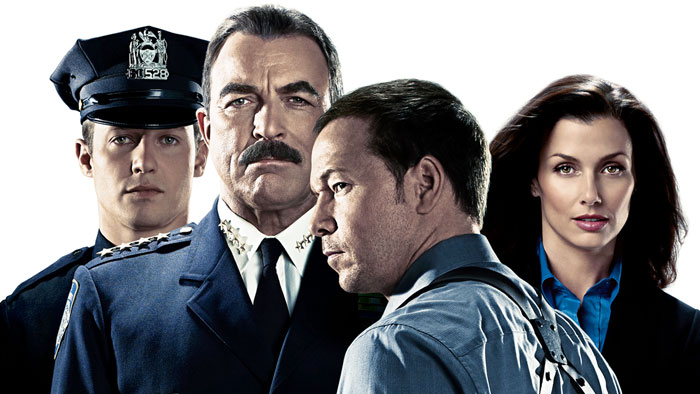
Just Finished Season 5 of Blue Bloods

BlueBloods

My wife and I just finished watching Blue Bloods. We watched it all through the end of season 5. There is no more for now… Groans and frustration. The next season starts in September 2015.  We watched it slowly over the last few months on Netflix and Amazon Prime.

We have enjoyed the characters and stories so much that we jokingly created a little dance (really just bobbing our heads and arms) that we break out during theme song to embarrass our children. I am not a ring tone kind of guy, but I considered getting the ring tone. I know, this is some serious nerd stuff

In case you aren’t familiar with the show… The story centers around the Reagan family. They have been involved in NYPD law enforcement for several generations. The father, Frank Reagan (played by Tom Selleck) is the police commissioner as his father was before him.  This adds an interesting dimension to the well-worn cop genre as the family often has to work through their own struggles and sometimes heated disagreements. Additionally there are the authority issues of having your dad being your boss and the most powerful law enforcement figure around. All of this makes for some good TV.

Here are several things I really enjoy about the show:

The depiction of an honest and ethical police commissioner is refreshing.  Throughout all 5 seasons the character of Frank Reagan plays a major role.  For me it is one of the best parts of the series. He is decisive, wise, insightful, and a man few words. He genuinely cares about the law, the people of New York, and his police officers. He frequently has to fight against political pressures, corruption, and enticements to compromise. Consistently his character holds firm and I found myself enamored by his resolve.  Here is an example: One phrase that gets repeated throughout the series is something like this: “It’s important to work as hard to exonerate an innocent man as to convict a guilty one.”

The Reagan family is far from perfect. To the contrary, they have a number of frustrating flaws. And yet the family is presented as virtuously catholic.  This is not a secondary element of the series. They actually pray in Jesus name.  It is a big deal and has felt so unusual that I have been shocked. The standard fair from Hollywood ubiquitously depicts christians as hypocrites or self righteous.  So it came as a shock to see them create characters that actually look like the people I know. One of the important plot lines throughout the show is the Sunday dinner where the family both laughs, cries, and argues their way through the difficulties of life. It is honest and often touching, without being sappy or cliched.

The cast also consistently displays the scars and wounds that face law enforcement families. So there is a fascinating juxtaposition: It is hard to love a job that ends up hurting you.  The show explores marriage problems, sibling rivalry, grief, PTSD, and moral failures that face law enforcement.

Additionally, the show is set in New York city.  This provides the ready opportunity to explore a variety of topics like gang violence, racism, police corruption, terrorism, stop and frisk policing, etc.

Any show that runs for 5 years will bump up against unrealistic situations and dialogue, and Blue Bloods doesn’t escape this. But it’s still worthy in spite of the little blemishes. I am looking forward to season 6.

Thoughts From The Other Side Of The Obergefell Decision

Thoughts From The Other Side Of The Obergefell Decision.

Some helpful thoughts in this essay by Hunter Baker from the Federalist.

Lots of people are agitated about the supreme court decision, and I understand why.  But I have also been scratching my head, because we really just traveled another mile down the road we were already traveling. This doesn’t seem like new “news” at all. It just makes official what has been happening unofficially for a long time.  Hunter Baker gives a good explanation of why this hurts for so many Christians:

“So, why the distress now? Why does Obergefell fall so heavily? It’s a little bit like being a child whose parents’ marriage is slowly disintegrating. But for years they held on. The kid knows a divorce is probably going to happen. The things that tied the family together have slowly been broken or dissolved in a long and painful process. But right up until the moment when it really happens, the child has hope. The parents criticized each other, refused to give credit, were eager to assign blame. And now it feels like it’s over. It’s not just over. Some people are throwing parties to celebrate. They’ve been hoping for this divorce for years and are thrilled to see it happen.”

He also tells a compelling story of his own journey to “real” faith in Christ (vs. the shallow cultural variety that was so common during his upbringing in the South) and how that same journey informs him now.

“Many are aglow in the wake of Obergefell. They didn’t like that old marriage between Christianity and the U.S.A. In fact, they thought America needed a new mate altogether. Call it scientific humanism or therapeutic deism, whatever. To them, this looks like the most hopeful moment yet.

“It’s hard to be the person at the party who isn’t celebrating. But I have no choice other than to be hopeful lest I discount my own conversion and spiritual quest. I believe Jesus is real and that he is the son of God. I know that men and women still seek him. Many will come as I did. He will change their lives forever as he changed mine. I know that the church and many Christians in times and places across history and around the globe have faced far greater challenges. No social change, no worldly court, no legislation will re-orient me.”


Gossiping About Ourselves

Face palm

Earlier today my wife and I were speaking about social media. It can be marvelous and miserable. We both dabble in Facebook, Twitter, Instagram, etc to varying degrees. But it is REALLY easy to be carried by the stream of pop culture and join in without thinking. So, we talk about social media. We talk about how it can be both amazing and horrible. We try to learn from our own failures (which are many) and even from the missteps of others.  Sometimes when you see several people (or whole crowds) making the same mistake all at once, it appears as a pattern.  A kind of constellation of immaturity and bad behavior.

It is almost as if the kinds of stupid decisions that people wanted to keep private in the past, have now become a staple on social media.

The constellation we talked about this morning is the tendency of some people to parade their bad decisions on social media.  Sometimes it feels like I am watching someone get another “together forever” tattoo with the name of their new lover, written just beneath the one they ditched last month.  It is almost as if the kinds of stupid decisions that people wanted to keep private in the past, have now become a staple on social media.  The grand spectacle of folly that was once reserved for gossip rags and the Larry Springer show is now available to all of us. And not just as spectators, we can be on stage, or on the cover.  But there is no one to sue for libel, because we wrote it. And, oh yeah,  it’s true..

Many of the things I am now able to learn (forced to endure?) about my Facebook friends would have only been available to me in the past if someone had been trying to destroy their reputation through gossip.  I would really like to mind my own business, but you won’t let me! It’s not that I want people to lie, I just feel really uncomfortable when people gossip about themselves.

I would really like to mind my own business, but you won’t let me!

And sadly much of this adolescent flaunting is presented with a measure of boldness. “This is who I am, IF YOU DON’T LIKE MY BAD DECISIONS, YOU ARE THE ONE WITH THE PROBLEM.”   And I do end up with a problem, Facebook only has a “like” button.  I could speak up and be perceived as judgmental (a risk I am willing to take because I love my friends), or stay quiet while you document your own personal episode of Jackass for the world to see.

Regret is a powerful experience, tasted by all at some point. And one of the things that makes regret more damaging is publicity. It is one thing to trip and fall. It is another thing to trip and fall on camera and then to see our private moment of shame become a viral experience. It is one thing to be laughed at by a few friends and strangers, it is much harder to endure the scorn of millions.  And sadly, this level of regret is more potent when there is a permanent record. What will it be like when the posts you wrote last year, the ones that already embarrass you, can be resurrected to go viral again in 2035. And you think political campaigns are nasty now? It has been said that taking information off the internet is like taking pee out of a pool. Impossible.

So here is my advise:

1. Don’t give into the temptation to make a permanent, public record of every mistake and bad decision that you make.  One day you will want people to “forgive and forget.” Don’t make this any harder than it already is.

2. If something might really embarrass you if it ended up on film, then don’t just think twice about posting it on social media, think twice about doing it.  Some embarrassing things are perfectly innocent, and we need to learn to laugh at ourselves. Other embarrassing things can hurt us and other people.  And the only thing worse than driving toward a cliff, is driving toward it confidently with your foot on the acclerator.

3. Don’t be upset when friends and people that love you (especially older ones) have the courage to tell you that you are making bad choices.   There is a strong possibility you will soon agree with them. And you may need their help to clean up the mess.

Photo used courtesy of Hobvias Sudoneighm. Some rights reserved.
Monday Morning Haiku- Power Outage

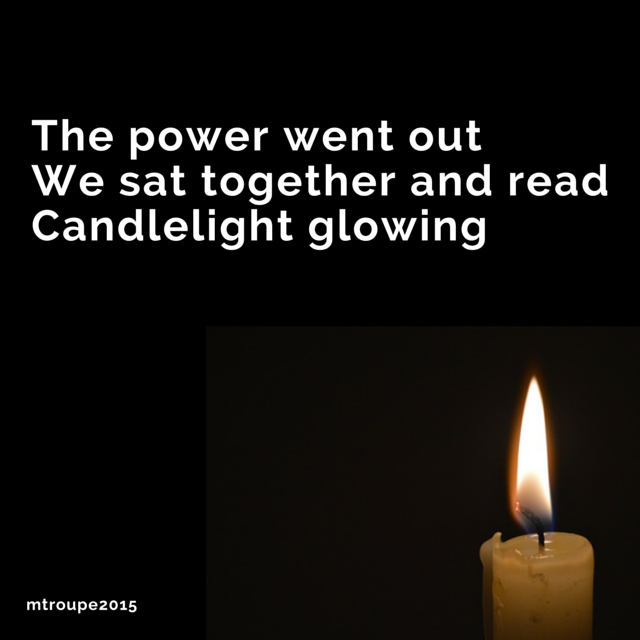
Candle graphic

Haiku 3.16.15

The power was out at our house for 3-4 hours last night, starting at dusk.  Even our cell internet connection was affected. We sat and read together and it was enjoyable. But it was a reminder of how completely dependent we are on technology, and how that even impacts our relationships.

What Now?

A power outage

Darkness. No lights. No Wi-Fi

Candles lit the room

-mtroupe 2015

Together

The power went out

We sat together and read

Candlelight glowing

-mtroupe 2015

Memory

Ancient people lived

Without electricity

But we forgot how

-mtroupe 2015

Design

Without light, dusk brings

An end to the work of Day

Now rest, talk, and sleep

-mtroupe 2015

Stick It To The Patriarchy! Close The Snow Shoveling Gender Gap

It’s Time To Close The Snow Shoveling Gender Gap.

This is a funny piece from Mollie Hemingway at the Federalist.  It is funny because, well…. It’s funny.

What makes it funny is that she is not trying to be serious. It would be absurd to complain about this. Men should do more snow shoveling, because they are men.   But many of the other voices crying foul about “gender gaps” are trying to be serious. They are trying to manufacture some real outrage over imagined injustice.  There are actually people taking a stand against The Tyranny of the Home Cooked Meal (and a response here), and how a play like the Vagina Monologues oppresses all the women without vaginas. Yes, you read that last sentence correctly, “all the women without vaginas.”  It would be funny if it was a joke. But it isn’t. The sad thing about this stuff is it detracts from all of the real oppression of women out there. And there is a lot of it.

Snow shoveling is done disproportionately by men, and that this leads to dozens of heart attacks every year.  A burden that women should share, right?

Also, 92% of workplace deaths happen to men.  In part because men tend to work in more dangerous professions.

Some highlights:

“Every winter, about 100 people in the United States die shoveling snow, according to the BBC.

A study looking at data from 1990 to 2006 by researchers at the US Nationwide Children’s Hospital recorded 1,647 fatalities from cardiac-related injuries associated with shovelling snow. In Canada, these deaths make the news every winter.

And some more:

“This relates to another, far more serious, gender gap problem in workplace fatalities.

Screen Shot 2015-03-05 at 8.27.29 PM

That’s from the Bureau of Labor Statistics at the Department of Labor. Males work 57 percent of the hours worked but suffer from a whopping 92% of the workplace deaths. Time for some equality of death, no?”

Speed Kills- Why The Pressure to Go Faster Is Eating Our Souls

Speed Kills – The Chronicle Review – The Chronicle of Higher Education.

Sometimes you read an article that powerfully says something you were already thinking, but had trouble putting into words.  This is one of those articles for me.  I am admittedly addicted to the same craving for speed that afflicts the rest of us. But more and more I am feeling cheated. I am feeling like I want to raise a protest. I want to “stick it to the man” that keeps yelling “SCHNELL!”

Mark Taylor has done a good job showing the deleterious effects of a lust for “more and more, faster and faster” on several dimension of our culture. He specifically discusses the impact on capital markets, communication, and education.

“The faster we go, the less time we seem to have. As our lives speed up, stress increases, and anxiety trickles down from managers to workers, and parents to children.”

Our ability to do things faster has had exactly the opposite effect that thinkers and politicians predicted.  We thought that being able to finish a job sooner would allow us to clock out and go home. That we would now have time for recreation, art, and family. Nope. Instead, “Contrary to expectation, the technologies that were supposed to liberate us now enslave us.”  He writes:

“With the emergence of personal computers and other digital devices in the late 1960s and early 1970s, many analysts predicted a new age in which people would be drawn together in a “global village,” where they would be freed from many of the burdens of work and would have ample leisure time to pursue their interests. That was not merely the dream of misty-eyed idealists but was also the prognosis of sober scientists and policy makers. In 1956, Richard Nixon predicted a four-day workweek, and almost a decade later a Senate subcommittee heard expert testimony that by 2000, Americans would be working only 14 hours a week.”

The quest for speed has been paired with our desire to measure success with numbers. This has destroyed or dismissed hard-to-count virtues like creativity, reflection, and problem solving. And Oh, yeah, what about happiness?  There is a difference between “rapid information processing,” the kind of thing we do when reading and writing online, and “slow, careful, deliberate reflection.”  By the way, when was the last time you read anything about “slow, careful, deliberate reflection.”   Yeah, me too.  Probably in too much of a hurry.  We are too busy to ask whether our pace is actually good for us.

By the way, when was the last time you read anything about “slow, careful, deliberate reflection.”

One of the other bad effects of speed is that it tends to diminish complexity in favor of simplicity. Now, simplicity is a good thing. But not everything is simple. And paradoxically, arriving at the kind of simplicity that is truly valuable takes a LOT of time. Greg McKeown has argued for this in his book Essentialism.  If you are going to figure out what is truly important you will need time and space to do it.

Life is moving too fast, and we are NOT better off because of it. Read this article and take another step toward deliberately slowing down.