A Tragic Irony Within The San Bernardino Shootings. You Can’t Make This Stuff Up

Several news outlets are posting memorial information about the victims of the cowardly murders in San Bernardino this week.  They are difficult to read, but worth the time, and help us to remember the human side of this tragedy. My heart breaks for these families.

I read this one and couldn’t get past the painful irony that is in the background of this man’s story.  Some in the media are working hard to overlook or minimize threads like this in favor of other narratives.

One of the victims was Nicholas Thalasinos:

“Thalasinos, who had been working as a health inspector, had a growth removed from his head just four days before being killed in the shooting, the Los Angeles Times reports.

“He had an incredibly good work ethic,” Ed Beck, the husband of one of his former colleagues, said. “The job of a sanitary inspector is certainly not the most glamorous of professions. He was passionate about it. He wanted to make sure people were safe.”

He has two adult sons.

“I want answers and I want them now, because now, it’s personal!” wrote friend Yael Zarfi-Markovich on Facebook.

He was a Messianic Jew who often defended Israel. According to the AP News Agency, he had got into a heated discussion with Farook [one of the shooters who was a radicalized jihadist] about whether Islam was a peaceful religion while working a few weeks ago.” (emphasis added)

Source: San Bernardino shooting: Who are the victims? – BBC News

How To Make Yourself and Your Kids Miserable: Helicopter Parenting

Evidently, helicopter parenting is all the rage. And the results are visible beyond the playground, all the way up to the nation’s most prestigious universities.

Perhaps this shouldn’t be a surprise, we have subtly and perhaps unknowingly shifted the meaning of family. Historically, families have been viewed as the context for teaching character and establishing our most important relationships.  More and more families are seen as a means to establishing financial success.

“Julie Lythcott-Haims noticed a disturbing trend during her decade as a dean of freshmen at Stanford University. Incoming students were brilliant and accomplished and virtually flawless, on paper. But with each year, more of them seemed incapable of taking care of themselves.  (emphasis added)

“At the same time, parents were becoming more and more involved in their children’s lives. They talked to their children multiple times a day and swooped in to personally intervene anytime something difficult happened.

“From her position at one of the world’s most prestigious schools, Lythcott-Haims came to believe that mothers and fathers in affluent communities have been hobbling their children by trying so hard to make sure they succeed, and by working so diligently to protect them from disappointment and failure and hardship.”

Source: Ex-Stanford dean explains why helicopter parenting is ruining a generation | Fresno Bee

Duty to Die: Author Says Too Few People in Oregon are Requesting Assisted Suicide

being mortal

How about this for piling on.

Here are my brief thoughts about someone else’s article. That article is kind of a review of a book review.  More like a response. And I just happened to finish that book, and I really enjoyed it. The book is called, “On Being Mortal” by Atul Gawande the Harvard trained surgeon who has produced a number of good books in the last decade. I have read them all 🙂

Anyway, Gawande’s book is about aging and dying and how the healthcare system has not done a very good job in actually helping people live better lives during the last phase of their journey. He spends a few pages talking about assisted suicide, and I would disagree with what he says (he thinks it is OK under some circumstances). But regardless of your position, he makes what I think is a compelling point. In America, and other countries, we are making huge strides in palliative care and hospice services.  And contrary to popular conception, those treatment modalities are not about helping people die as much as to live as well as they can during those difficult days.  People with painful and  incurable diseases are choosing to live out their days with family and finding more dignity than they knew was possible. And it is worth mentioning that how we live when we are dying is an important part of the human journey. How the story ends is truly important.

But it seems that in the Netherlands, the availability of assisted suicide has become the quick fix that has railroaded more promising alternatives. Rather than developing health care systems that can help people live full lives to the end, they have opted instead for something more sinister in the name of “dignity.”  Here is a quote from Gawande’s book, ”

 “I fear what happens when we expand the terrain of medical practice to include actively assisting people with speeding their death. I am less worried about abuse of these powers than I am about dependence on them.”

“The implication is that we might begin to substitute assisted dying for palliative care and hospice. He points to the experience in the Netherlands, where he says the fact that “one in thirty-five Dutch people sought assisted suicide at their death is not a measure of success. It is a measure of failure.”

The author of the article at LifeNews.com, Wesley Smith J.D. makes a point that is even more disturbing. Marcia Angell, an author who is an advocate for assisted suicide, has been quoted as saying, “I am concerned that too few people are requesting it. It seems to me that more would do it. The purpose of a law is to be used not to sit there on the books.”

Is this debate about presenting options that people want, or imposing your choice on others?

Source: Duty to Die: Author Says Too Few People in Oregon are Requesting Assisted Suicide | LifeNews.com

Helping People Learn By Letting Them Fail Is Essential – 6 Recommendations To Fail Well

randy pausch

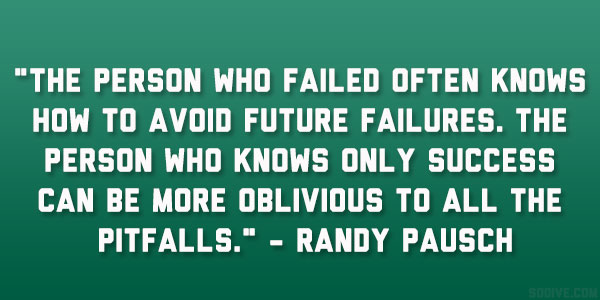
Here is a great (and brief) article on the importance of failure in developing character, growing businesses, and helping people have a good life.  It turns out that trying to spare people (ourselves, our children, our employees, etc) from experiencing the pain of failure is bad in the long run.  Why? We can’t gain deep wisdom without the process of learning from our failures.  This is a list from the article at Forbes.com of ways to help people fail in a way that is positive for them and the organization.

“Here are some ways to increase employees’ comfort with the risk of failure, and to be resilient when it happens:

  1. Share past stories of struggle. Everyone’s been there.
  2. Practice recovery so people aren’t paralyzed by failure. When I was coaching sports, we didn’t just diagram plays. We always developed a Plan B. That’s why great organizations scenario-plan. It helps people think of struggle as part of the process.
  3. Help people around you think like long-term investors in their own ideas and their own careers. The aim shouldn’t be to try to have one uninterrupted string of successes, but rather to have a portfolio of some winners and, yes, some losers.
  4. If someone is struggling, your job is to figure out how to get them on the right path. The real job of a manager is to help people learn from failure and move forward.
  5. Champion failure that turns to innovation. Find examples where ordinary failure has led to extraordinary opportunity.
  6. Encourage failing fast. Sometimes we recognize that something is failing, and our instinct tells us to push harder to make it succeed. Knowing when to pull the plug is always difficult but is necessary.”

Source: Helping People Learn By Letting Them Fail Is Essential – Forbes

A Happy Atheist Challenges The Angry Atheists With The Difference Between A Fact And A Value

I have read several articles by John Gray and enjoy his writing and insight.  I know when an author is connecting with something important to me because I talk out loud while I am reading it.  I mumbled pretty much the whole time I was reading this one. I had to stop and reread several paragraphs for effect, and kept interrupting my wife to read several of his more powerful points to her. Yes, I am a nerd. This essay put into words a number of things I have been thinking.

Gray is not a believer, and so he has a very different outlook than I do (as a Christian), yet his awareness of the history of philosophy allows him to see the naked spots in the emperors wardrobe. He is disenchanted by the vocal tribe of evangelistic atheists that seem to be known for their pulpit-pounding-religion-hating self righteousness. (Dawkins, Harris, etc.) And he takes them to task, not because of their unbelief but because of their inconsistencies in applying what they believe.  He is willing to explore the assumptions beneath their beliefs, and finds them to be often unreasonable.

In this essay, Gray very briefly chronicles the racist behavior of 19th and 20th century evolutionary atheists.  Then he freely acknowledges that while modern atheists disavow these beliefs, they have repeated some of the same intellectual mistakes as their forbears. They have failed to acknowledge the difference between facts and values.  And this is a dialogue-ender if you happen to disagree with them because you will be talking about your values while they dismiss you as unscientific. They believe that their values are scientific, and therefore as unassailable as discussing gravity.  And sadly, too often this leads them to view their opponents with patronizing contempt.

By the way, this was the same problem with the communism of Russian and China. Marx’s writings insisted that his view of economics was “scientific.”

I paused to read several parts of this essay more than once, not only to understand his observations, but also to enjoy them.   I disagree with his view of the world, but enjoy his intellectual honesty and clear view of the logical problems in the foundation of the new atheism.

“It has often been observed that Christianity follows changing moral fashions, all the while believing that it stands apart from the world. The same might be said, with more justice, of the prevalent version of atheism. If an earlier generation of unbelievers shared the racial prejudices of their time and elevated them to the status of scientific truths, evangelical atheists do the same with the liberal values to which western societies subscribe today – while looking with contempt upon “backward” cultures that have not abandoned religion. The racial theories promoted by atheists in the past have been consigned to the memory hole – and today’s most influential atheists would no more endorse racist biology than they would be seen following the guidance of an astrologer. But they have not renounced the conviction that human values must be based in science; now it is liberal values which receive that accolade. There are disputes, sometimes bitter, over how to define and interpret those values, but their supremacy is hardly ever questioned. For 21st century atheist missionaries, being liberal and scientific in outlook are one and the same.”

“For 21st Century atheist missionaries, being liberal and scientific in outlook are one and the same.”

Some other big ideas from this essay:

  • Atheism is not monolithic, and most of the values (and fact claims) advocated by modern skeptics are not self evident, and are not agreed on by everyone in their camp. This alone should challenge their confusion of facts and values.  I have some atheist friends that like to point out how hard it is to find Christians to agree on any matter of doctrine. Well, evidently they live in the same world.
  • Many of the new atheists are ignorant of the nature of their own beliefs. They take their own view of the world for granted and are unwilling to subject it to the same intellectual scrutiny that they demand from others.
  • New Atheists have largely ignored the writings of Nietzsche. Why? Gray writes, “The reason Nietzsche has been excluded from the mainstream of contemporary atheist thinking is that he exposed the problem atheism has with morality. It’s not that atheists can’t be moral – the subject of so many mawkish debates. The question is which morality an atheist should serve.”  Which is to say that Scientific atheism does NOT lead to a self evident view of the moral world. It cannot answer the most basic questions about how we should live without departing from its limiting scientific commitments. Further, many of the tenets of humanism advocated by atheists actually derive from Judeo-Christian religious tradition.
  • The hostility to religion that has been on display from the evangelistic atheists doesn’t make any rational sense.  After mentioning several influential atheists from the past that were NOT hostile to religion, Gray writes, “Above all, these unevangelical atheists accepted that religion is definitively human. Though not all human beings may attach great importance to them, every society contains practices that are recognisably religious. Why should religion be universal in this way? For atheist missionaries this is a decidedly awkward question. Invariably they claim to be followers of Darwin. Yet they never ask what evolutionary function this species-wide phenomenon serves. There is an irresolvable contradiction between viewing religion naturalistically – as a human adaptation to living in the world – and condemning it as a tissue of error and illusion. What if the upshot of scientific inquiry is that a need for illusion is built into in the human mind? If religions are natural for humans and give value to their lives, why spend your life trying to persuade others to give them up?”

I disagree with Gray on much of this, but his point is a good one. If atheism and evolution is true, then it follows that religion is a survival adaptation.  If that is true, why so much angst over gene expression?

Source: What scares the new atheists | John Gray | World news | The Guardian

Ancient Trees: Woman Spends 14 Years Photographing World’s Oldest Trees

An amazing photo essay all about old trees. Makes me want to buy her book Ancient Trees: Portraits of Time

Beth Moon, a photographer based in San Francisco, has been searching for the world’s oldest trees for the past 14 years. She has traveled all around the globe to capture the most magnificent trees that grow in remote locations and look as old as the world itself.

Source: Ancient Trees: Woman Spends 14 Years Photographing World’s Oldest Trees | Bored Panda

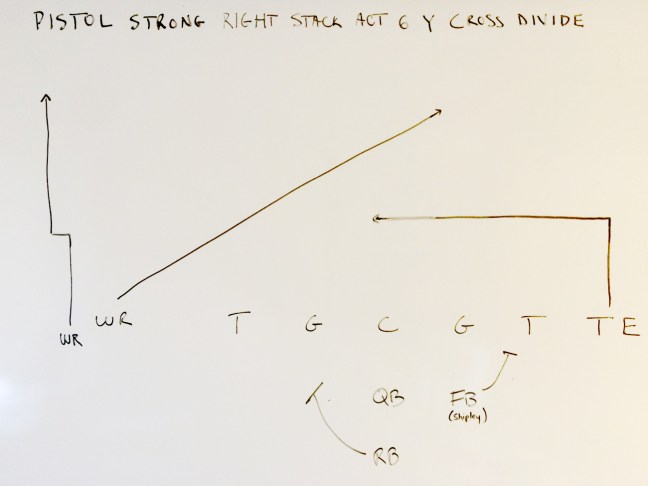
A Week of Preparation For an NFL Quarterback.


So what is really involved each week for an NFL quarterback to learn the game plan and prepare for the big game? A LOT MORE than you probably think. And NFL football is much more complicated than the average person can imagine.

Looking at this is not only fascinating, it is instructive on how dedicated these athletes and coaches are to the mental side of their jobs.

Peter King at the MMQB has this write up walking through a week with Carson Palmer, quarterback for the Arizona Cardinals. It is a fascinating looking into a very high level of focus, effort, and dedication. And it shows how some new technologies are affecting their preparation. Very cool. I have really enjoyed Peter King’s work in covering the NFL. Last year I felt like his series on NFL Referees was one of the most interesting and informative things I read on sports all year.

Source: Arizona Cardinals’ Carson Palmer goes inside a game plan for MMQB | The MMQB with Peter King

A Worthwhile Documentary on Netflix: The Green Prince (2014) – IMDb

I have an interest in international affairs and understanding how intelligence agencies do their work. So I was taken in by the description of the film on this list of 50 best documentaries on Netflix. I also watched Happy Valley about the Penn State Child Abuse scandal. That is worth watching as well if you like the cultural side of football.

Last night we watched the documentary “The Green Prince” which is currently available to stream on Netflix. The show is mostly the dialogue of 2 individuals: The son of the leader of Hamas who became an informant for Israeli intelligence, and his Shin Bet (Israel’s internal security agency, something like our FBI) handler. The dialogue is peppered with photos, video footage, and news stories concerning the events. It won a ton of awards, and for good reason. It is a fascinating first hand look into the world of the Palestinian struggle and the intelligence world behind it.

Source: The Green Prince (2014) – IMDb

If We Are Unaware of Human Suffering, Does It Exist? Thoughts on Chronic Pain

My sister posted this article on Facebook recently. She suffers from chronic pain and has had trouble getting a diagnosis. This article by psychologist/ neuroendocrinologist Chandler Marrs discusses pain in terms of a philosophical principle. We don’t need to be in the forest to believe that trees fall when we are not there, and that they make noise even when no one is around to hear them.  She says that we tend to think that “awareness predicates existence,” when that is clearly not true. If we close our eyes, the world doesn’t cease to exist.

The big idea in this article involves depending on our ability to “measure” pain objectively as prerequisite to its existence. Does pain only truly exist only when the clinician can objectively perceive it? Is it possible that there are some disease states for which we do not yet have adequate tools to be able to measure it? The fact that millions of people complain of pain where clinicians cannot identify the causes should make us consider the limits of our knowledge and tools. 

Why is this important? In my experience as a healthcare provider, if someone higher in the chain of command ran all the available tests and couldn’t identify a known cause for the pain, then often the conclusion was not favorable. We thought that the patient was seeking drugs, or that they had some kind of mental imbalance. The polite term may have been “somatoform disorder.”  They were often lumped into that big diagnostic basket of “fibromyalgia,” which basically meant “you have pain and we can’t find a reason for it.”  This label could easily function as a flag to dismiss the reality of the patient’s claims.

Marrs also discusses how our perception is affected by our humility and our humanity.  Our compassion is based on our ability to believe that another person is truly suffering.  A lack of empathy can result in an inability to perceive someone else’s problems.

If we put these two factors together we may find that our insensitivity prevents us from believing someone’s  complaint, and concluding that it is not real.  And since there are real “malingerers” and drug seekers out there, we can easily put people into that category when they don’t fit. The result is tragic.

She writes:

“In the case of modern medicine, if the suffering is invisible to current diagnostic tests and intractable to medical therapeutics, it is not real. Indeed, whether cognitively or reflexively, every time a physician dismisses a patient’s complaint or prescribes an anti-depressant for pain, he denies the existence and veracity of their suffering. He denies the tree in the forest, because he does not see or hear it himself in the context necessary to recognize it – e.g. by currently available diagnostic technologies and taxonomies. Here, medical technology, and the physicians who wield the technology, assume an infallibility that precludes the existence of realities beyond their sight lines, beyond their control.”

Source: If We Are Unaware of Human Suffering, Does It Exist? – Hormones Matter

Haiku Pine Needles

Pine Trees

Written several weeks ago while I was taking some days away at a cabin.

Scattered

Pine needles scattered

Latticework beneath the trees

Draped on everything