An Unexpected Way To Learn From Our Failures

learning from Failure

Common sense tells us that we should learn from our mistakes.  Well, as Voltaire said, “Common sense is not so common.”

Some of the best learning available comes from failure.  This learning can be intellectual- like trying and failing to solve a math problem.  Or this learning can be moral- realizing that revenge and bitterness is self destructive, it eats away at your own soul.

In order to really learn from our mistakes we need to be deliberate.  We need to spend time thinking about why we failed.  The kernel of folly is to keep repeating the same mistakes over and over. Every time we complete a project, achieve a milestone, or fall on our faces we have a chance to become our own teachers. The opportunity is especially rich when we fail.  A lot can be learned in the post-mortem examination of disappointment. About life. About ourselves.

Nothing shocking about that.

But there is another amazing opportunity that is lurking in our failures. And that is the idea of serendipity.  Serendipity is an accidental discovery. It is a happy accident. It is the pleasant surprise of looking for one thing, and finding something else, often something entirely different yet wonderful.  And many of the most amazing advances in human knowledge and culture have been made “by accident.”  And this is more common than you might think. Penicillin, microwaves, Velcro, Teflon, vulcanized rubber, Coca-Cola, radioactivity, the Post-it note, and Viagra were all the result of “accidental discoveries.”  In reality the list is much longer.

According to Steven Johnson in his book, “Where Good Ideas Come From,” one of the key elements in taking advantage of serendipity is paying attention. Evidently small versions of these accidental discoveries are all around us, but we may miss them if we don’t recognize them.  And we won’t recognize them if we don’t slow down and pay attention.  This involves taking the time to think about what is happening and why.

Here is another reason to be willing to fail and to learn from your failures. You might learn how to do better next time. Or you might discover something else altogether. Something that could change the world forever.
Happiness is Not Found in Different Circumstances

“He who has so little knowledge of human nature as to seek happiness by changing anything but his own disposition will waste his life in fruitless efforts and multiply the grief which he purposes to remove.”

Samuel Johnson

21 Surprising Statistics That Reveal How Much Stuff We Actually Own

21 Reasons

Here is a list of 21 factoids to “prove” (if you had any doubts) that Americans suffer from possession gluttony.  We are obese from stuffing our lives full of empty possessions.  Our closets, drawers, and garages are crammed with decades of detritus.  A few of these statistics seem suspect to me, but overall the point is clear. We have too much stuff.

What is the problem with having this much stuff? 2 things stand out. First, it is unique in our own history. By the standard of any previous generation we are all hoarders.  So much for being on the “right side of history.”  Second, it is bad for us.   Owning this much stuff, the way we own it, has adverse effects on our daily routines, our financial bottom line, our mental health and our relationships.

“19. Over the course of our lifetime, we will spend a total of 3,680 hours or 153 days searching for misplaced items.The research found we lose up to nine items every day—or 198,743 in a lifetime. Phones, keys, sunglasses, and paperwork top the list”

#19 above stood out to me because I have experienced it, and I have family members that face this daily.  We have so much stuff that we forget what we have. We are afraid to “throw it away” because it has value. And we might need it some day.  But unless we become full time archivists of our own stuff there is no way we can remember and/or locate what we need.  The result? We go out and buy another one of the very thing that we need, but already own. And this happens because we can’t find it.

And by the way, even if we could keep everything catalogued… is that really what we want to spend our precious attention on?

Consider this. The size of our homes has tripled, and they still aren’t big enough so we have to rent a storage facility.  I think we should make it a weekly habit to throw things away or donate them. Just this week we took 3 boxes of old housewife and decorations to the thrift store. They were good items, they have value. But we realized they have a negative value to us. Someone else can use it and the rescue mission can benefit from the resale.  Win. Win. Win by losing unnecessary stuff!

via 21 Surprising Statistics That Reveal How Much Stuff We Actually Own.


Photo courtesy of Kevin Utting. Some Rights reserved

Your Anxiety Is Ruining Your Furniture

old chair

A fascinating anecdote from Mark Buchanan about stress and anxiety:

“Anxiety and stress are our number one killers. I heard recently a story about Meyer Friedman, the psychologist who devised the Type A/ Type B personality profiles— where Type B is placid and limber, taking life as it comes, and Type A is two-fisted and bristling, taking life by the horns. Friedman’s initial insight that led to his personality theory came after a discussion with a chair upholsterer. The upholsterer said that most of his business came from replacing the upholstery on the chairs in cardiologists’ offices, the chairs wore first, and quickly, on the front edge. Apparently, heart patients are so impatient that, even while listening to their doctor’s life-threatening diagnosis or lifesaving prescription, they sit taut and restless, poised to flee, chafing at the delay. At the edge of their seats. The very reason their hearts are sick is written in that threadbare upholstery.”

Buchanan, Mark (2007-03-11). The Rest of God: Restoring Your Soul by Restoring Sabbath (pp. 109-110). Thomas Nelson. Kindle Edition.

Is Real Life Too Boring for Social Media, or Have We Lost Touch With Goodness?


Kyle Vanhemert of Wired magazine writes about a new social media app (Beme) that is supposed to help us overcome the unreality of our staged, edited, and photoshopped lives on social media. The need is real and the concept has merits, but the review is critical on several fronts.   The observation that struck me is a reflection on what has become “the curated self” and how that self is so often different from the real self. And how disappointed we are with our “real selves” and our real lives.  Our homes, and our children, our dinners, and our vacations seem so “ho-hum” compared to uninterrupted ecstasy that everyone else enjoys.

“SOCIAL MEDIA APPS encourage us to share certain parts of our lives and particular versions of our selves. Judging by Facebook, you’d think everyone you know is in a happy, healthy relationship—it’s weird to post a status update saying you’re lonely or pining for your ex. Instagram’s no different: You share a pic of your meal at the hot new brunch spot, not the French-bread pizza you just warmed in the microwave.

“You might call this phenomenon the rise of the Curated Self.”

After noting several problems with the app, the author writes, “a more vexing problem might be something closer to the heart of sharing itself. Namely, that for most of us, authenticity is boring. Most of my meals aren’t worth showing off. Most of the sunsets I see aren’t particularly brilliant. This is why Instagram first blew up, after all: Its filters made our ordinary lives look extraordinary. This same appeal holds true for many of today’s most popular social apps. Life is usually more interesting when it’s edited and scrutinized before being rebroadcast.” (emphasis mine)

This makes me wonder if we even know what the real problem is and where it resides.  Is everyone else’s life really such a bore that we have to lie about it? Or have we lost a definition of what is worthwhile in life?  Are we immersed in deep and rich wonder, but to blinded to see it? And is social media feeding this great deception?

via Beme Has a Problem: Authenticity Is Boring | WIRED.

Essentialism Ch. 5 Questions for Discussion- The Escape


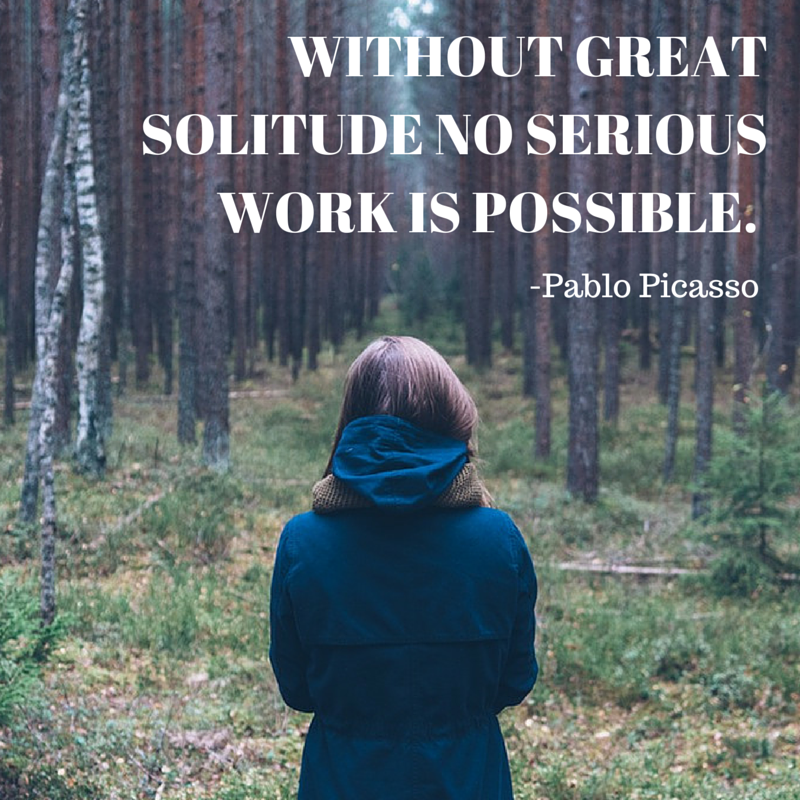
Solitude Quote Picasso

Questions for Essentialism  Chapter 5

This is a list of discussion questions to help work through the content of the book “Essentialism” By Greg McKeown.

Download a pdf of these questions here: Essentialism Questions Ch. 5

Major principles:

In order to figure out what is essential we need designated times and spaces in order to think.  These must be free from other obligations and distractions.

Key examples/illustrations

  • “Do not call Monday” from Frank O’brien of Conversations
  • The d.school at Stanford and their thinking spaces.
  • Isaac Newton and his time of solitude writing the Principia Mathematica
  • Jeff Weiner CEO of LinkedIn schedules 2 hours everyday where nothing is planned.
  • Bill Gates habit (think week) of taking 2 weeks off each year to read and think.
  1. Often our distracted schedules and frenetic pace prevent us from having time to think and reflect. How would you rate your life and schedule in this regard? Does the idea of carving out time for this seem like a reality in your life?
  2. Frank O’brien sets aside one day per month for his employees to get away to think and reflect. This helps them maintain a level of clarity and innovation.  Availability for this is also a barometer for him to understand his work force. “If somebody can’t make the meeting because of too much going on, that tells me either we’re doing something inefficiently or we need to hire more people.”   What does this barometer say about your life?
  3. It is often difficult to make time and space for reflection because of our daily demands.  We get caught up responding to needs and emergencies that we cannot extricate ourselves to improve the systems and organizations behind the emergencies. Which parts of your weekly/monthly schedule keep you from time to reflect?
  4. What is keeping you from scheduling uninterrupted time for peaceful reflection?
  5. Do you have a place where you can “escape” and think? How well is this working? List 3 possible locations you can use to escape the calls, tweets, emails, and emergencies that keep you from time to reflect.
  6. According to McKeown, “focus is not only something we have, it is something we do.”  What keeps you from “doing” focused work? Make a list of the top 5 interruptions and distractions in your life and business.
  7. What can you do to get several hours away from these top interruptions and distractions from #6?
  8. Does technology distract you? What aspects of your connectivity hinder you from the most important things?  (smart phone, social media, email, voicemail, etc).
  9. McKeown tells the story of the highly distracted executive that just couldn’t disconnect. In a moment of desperation he decided to give his phone away and to go to a motel with no internet access to get work done. He stayed there for 8 weeks until the major project was completed. What major project or life goal could you accomplish if you were willing to get away for just a day or two? Explore this idea before moving on.
  10. What nonessential things can you give up so that you can schedule regular (weekly/monthly) time for solitude and reflection?  List something to give up or “quit” this week for a higher purpose.
  11. Jeff Weiner of LinkedIn said his single most valuable productivity tool was planning 2 hours every work day where nothing else was scheduled.  (p. 68) Right now take a moment to dream (in writing) about how your life and work would change if you did this? What can you imagine would happen to your stress level? To your focus? To the way you treat others? To your productivity?
  12. Whether you take a whole day or week off to read and think, where can you build in a small amount of time to enrich your mind and soul through reading and thinking?
  13. List 3 books/articles that can help you understand your life/business/market better.  Take a moment to write out what the potential benefits of this. If you can’t think of any, write down the names of 2 people you can talk to for suggestions. What will you ask them?

Gossiping About Ourselves

Face palm

Earlier today my wife and I were speaking about social media. It can be marvelous and miserable. We both dabble in Facebook, Twitter, Instagram, etc to varying degrees. But it is REALLY easy to be carried by the stream of pop culture and join in without thinking. So, we talk about social media. We talk about how it can be both amazing and horrible. We try to learn from our own failures (which are many) and even from the missteps of others.  Sometimes when you see several people (or whole crowds) making the same mistake all at once, it appears as a pattern.  A kind of constellation of immaturity and bad behavior.

It is almost as if the kinds of stupid decisions that people wanted to keep private in the past, have now become a staple on social media.

The constellation we talked about this morning is the tendency of some people to parade their bad decisions on social media.  Sometimes it feels like I am watching someone get another “together forever” tattoo with the name of their new lover, written just beneath the one they ditched last month.  It is almost as if the kinds of stupid decisions that people wanted to keep private in the past, have now become a staple on social media.  The grand spectacle of folly that was once reserved for gossip rags and the Larry Springer show is now available to all of us. And not just as spectators, we can be on stage, or on the cover.  But there is no one to sue for libel, because we wrote it. And, oh yeah,  it’s true..

Many of the things I am now able to learn (forced to endure?) about my Facebook friends would have only been available to me in the past if someone had been trying to destroy their reputation through gossip.  I would really like to mind my own business, but you won’t let me! It’s not that I want people to lie, I just feel really uncomfortable when people gossip about themselves.

I would really like to mind my own business, but you won’t let me!

And sadly much of this adolescent flaunting is presented with a measure of boldness. “This is who I am, IF YOU DON’T LIKE MY BAD DECISIONS, YOU ARE THE ONE WITH THE PROBLEM.”   And I do end up with a problem, Facebook only has a “like” button.  I could speak up and be perceived as judgmental (a risk I am willing to take because I love my friends), or stay quiet while you document your own personal episode of Jackass for the world to see.

Regret is a powerful experience, tasted by all at some point. And one of the things that makes regret more damaging is publicity. It is one thing to trip and fall. It is another thing to trip and fall on camera and then to see our private moment of shame become a viral experience. It is one thing to be laughed at by a few friends and strangers, it is much harder to endure the scorn of millions.  And sadly, this level of regret is more potent when there is a permanent record. What will it be like when the posts you wrote last year, the ones that already embarrass you, can be resurrected to go viral again in 2035. And you think political campaigns are nasty now? It has been said that taking information off the internet is like taking pee out of a pool. Impossible.

So here is my advise:

1. Don’t give into the temptation to make a permanent, public record of every mistake and bad decision that you make.  One day you will want people to “forgive and forget.” Don’t make this any harder than it already is.

2. If something might really embarrass you if it ended up on film, then don’t just think twice about posting it on social media, think twice about doing it.  Some embarrassing things are perfectly innocent, and we need to learn to laugh at ourselves. Other embarrassing things can hurt us and other people.  And the only thing worse than driving toward a cliff, is driving toward it confidently with your foot on the acclerator.

3. Don’t be upset when friends and people that love you (especially older ones) have the courage to tell you that you are making bad choices.   There is a strong possibility you will soon agree with them. And you may need their help to clean up the mess.

Photo used courtesy of Hobvias Sudoneighm. Some rights reserved.

A Bright Spot At A Nursing Home

Elderly

Earlier today I went to visit my mom. She has lived in a nursing home for more than a year. She was recently admitted to the “regular” hospital for a severe infection in her legs.  The skin is red, and swollen, and hard from just below the knee. It is “cellulitis.” She has had battled this unsuccessfully for years.  The medications fight off the infection, but it always returns with fire. This time it was bad.  The doctor said if it wasn’t treated she could end up loosing her legs. At the hospital, the lab tests revealed it was a drug resistant strain- MRSA.

After several days she was able to return to the nursing home. She will be confined to an isolation room for a while. But she still has her legs, thank God.  Though they still look red and swollen.

After wiggling my large frame into the required yellow gown, and putting on the gloves, I entered her room. My dad was there visiting her, as he does every day.  He is there every day his own health allows him to come.  While I was there a couple of things occurred to me.

First, I am aware of my father’s love for her.  Today she was doing so-so. Not the best, not the worst.  But her mind wasn’t clear. Whether it was the medications or the infection, she was drifting off to sleep.  When she spoke, it made some sense, but something wasn’t right.  She reminded me of the aged Bilbo in the last Lord of the Rings movie. She would fall asleep while sitting in her wheel chair and the sudden bob of her head would startle her awake. Then she would look around embarrassed a little and laugh. We both encouraged her to lay down.  She took a long time to make this short journey. She kept getting distracted and falling back asleep. She rearranged the dishes on her tray.  She rechecked the locks on the wheel chair. She switched some of the pillows. It was frustrating because we were standing there waiting to help her and it was almost like she didn’t realize this.

And my dad was there. I made eye contact with him, both of us realizing that something wasn’t right. That her behavior was awkward. I smiled to him, trying to indicate that it was OK and there was no need for excuses or embarrassment. He smiled back. He is 78, and his own health is not great. He has battled through cancer, a heart attack, and several vascular surguries. But he is a faithful man in the real sense of that word.  And he has kept his vows to love my mother through the long years of sickness. To love her when love isn’t easy. To love her when the doctors don’t have any answers and there isn’t much hope. I was there with them today and this is what stood out to me.  His love. A bright light in a dark cave.  No doubt this is a gift of God’s grace. I am thankful for a dad like this. I want to be like him.

Second, I thought about my own future. This could be me some day. If I have the privilege of growing old, one day my body will give up. I may end up in a nursing home. What would that be like? I know my mom hates it here.  When we talk about this, I usually remind her that this is the best we can do under the circumstances. The nursing home is actually a pretty good one. But still no one wants this. But all things considered, this is where she can get the care she needs. And even with all this, she is still pretty sick. Maybe some day, this will be me. How would I feel about it?

Or maybe I will be the one visiting. Maybe my wife will be the one that is sick and stuck in a tough spot.  Today as I visited my mom, I was aware of the possible future that I would rather not consider.  But, I want to at least think about this. And I want to take it seriously. And I want to behave differently because I thought about it. I don’t want to arrive here at some point in the future and hate myself because I was too proud or too rushed to make such deliberations.

Photo Courtesy of Xavi Talleda. Some rights reserved

“Will I Ever Find a Man To Love Me Like That?”

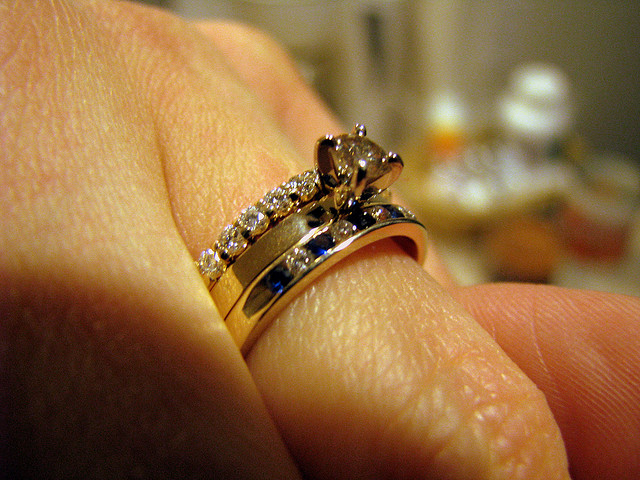
Ring

This is a very moving story about a man that loved his wife through 20 years of sickness with Alzheimer’s.  Truly,  love is more than a feeling. This episode is recounted by Ravi Zacharias in his book “Jesus Among Other Gods.”

“Dr. J. Robertson McQuilkin was formerly the president of Columbia Bible College and Seminary. He is one of the most remarkable people in our world. He is a conference speaker and author of note. But none of those credentials exceed his exemplary and heart-gripping love for his ailing wife, Muriel. She has walked down the grim and lonely world of Alzheimer’s disease for the last twenty years. Dr. McQuilkin gave up his presidency and numerous other responsibilities to care for her and to love her. He has penned his emotional journey in one of the most magnificent little books ever written. At one point in the book he recounts this incident:

“Once our flight was delayed in Atlanta, and we had to wait a couple of hours. Now that’s a challenge. Every few minutes, the same questions, the same answers about what we’re doing here, when are we going home? And every few minutes we’d take a fast paced walk down the terminal in earnest search of—what? Muriel had always been a speed walker. I had to jog to keep up with her!

“An attractive woman sat across from us, working diligently on her computer. Once, when we returned from an excursion, she said something, without looking up from her papers. Since no one spoke to me or at least mumbled in protest of our constant activity, “Pardon?” I asked.

“Oh,” she said, “I was just asking myself, ‘Will I ever find a man to love me like that?’”

McQuilkin, J. Robertson. A Promise Kept. Wheaton, IL: Tyndale House, 1998. Print. pp 18-19


Photo used by permission Mr. Thomas. Some rights reserved.

Seeing the Beauty of Christ Through Brokeness: Book Review


Beauty Brokenness

This is a short book (I read it in one day, a little more than an hour- I guess that makes it a booklet) and for only .99 on Kindle you can’t beat it. I would recommend the book to add to your perspective on pride, humility and suffering.

It is full of some golden observations on the need for humility in the Christian life, and especially in ministry. It speaks a note that is frequently missing, and one we would rather not face.  We would all like success without the pain of failure, suffering, and self-denial. But God uses these important teaching lessons to bring us the greatest joy and greatest usefulness. I love the emphasis in this book on the importance of character and humility over the value of personal skills and gifts.  The book is full of practical stories that flesh out his ideas, and these are helpful. He is also honest about his own pride and struggles and reveals how the Lord has humbled him. That is a rare trait as a leader. It makes me want to meet him!

I am a little at a loss about the title. The book isn’t really about the beauty of Christ. It is more like the value of brokenness as a prerequisite to usefulness in ministry. At least that was my perception.  I think this is important, because one of the most valuable things that happens in suffering is that the Lord is stripping away all of our false trusts in order to show us why Jesus Christ is better than those trusts.  There are hints of this in the book, but not as much about the beauty of Christ as I expected. It is possible to be stripped down and not be strengthened in Christ, and that is not at all a valuable thing. I am pretty sure the author would agree with me on this.

At a number of points he makes some statements that I disagree with, and those may reflect his theological perspective. I am not sure what his background is, so I can’t comment. But his emphasis on free will and talk about what God “cannot” do made me pause at several points. Also, the way he suggests that Jesus needed to be broken seems strange to me,  Jesus submitted to the cross because of our sin not because of any lack in himself.  His death is an example and a patter for us, but our need to be broken is because of our sin and self sufficiency.  His need to be broken was because we aren’t what we ought to be.

There is also an emphasis on our need to choose to be broken that seems to leave out an the miraculous movement of God to change the heart through the Holy Spirit apart from our permission.  Or perhaps I should say, that we come to the point of giving our permission because his grace has changed us, and only because of that miracle.  Of course he uses suffering as one of his tools, but he also uses the Holy Spirit blessing the word of God. There are many people that suffer and are still never broken. Others suffer and become humble and teachable. The difference is more than the will of man, it is the miraculous grace of God. Otherwise I could say that I am humble because of my choice and he is proud because he failed to make the choice that I made.

In spite of my reservations theologically, the book still has a lot of value. Thank you to the author  for writing and sharing your experience.